
.50 Cal vs .68 Cal Self-Defense Launchers: Which Caliber is Right for Your Home?
Choosing a less-lethal launcher for home protection often comes down to one question: .50 cal vs .68 cal. Both can be effective when paired with the right projectiles and realistic expectations—but they behave differently in recoil, payload, ammo availability, and how forgiving they are for new users.
This guide focuses on a practical self defense caliber comparison for Canadian buyers: what each caliber does well, what it doesn’t, and how to choose the best defense launcher caliber for your home layout, comfort level, and training commitment.
Quick takeaway: .50 cal and .68 cal solve different problems
If you want a simple decision rule for home defense caliber selection:
- .50 cal tends to be easier to handle, quicker to deploy, and more comfortable for smaller hands or recoil-sensitive users. It’s often chosen for compact “grab-and-go” setups and for people who want controllability and straightforward operation.
- .68 cal tends to deliver a larger projectile and can be more intimidating visually, with a different impact “feel” depending on the projectile type. It’s often chosen by users prioritizing maximum payload size and broader compatibility with many paintball-style formats.
Neither is “best” in every home. The right choice depends on your priorities: handling, projectile selection, indoor practicality, and how you plan to store and stage the launcher.
What “caliber” means for less-lethal launchers
In this context, caliber refers to projectile diameter:
- .50 caliber projectiles are about 12.7 mm in diameter.
- .68 caliber projectiles are about 17.3 mm in diameter.
That diameter change has real effects on how the launcher feels and performs: it influences projectile mass, how much payload can be carried inside specialty rounds (like irritant/powder-style), how much surface area hits a target with solid/rubber rounds, and often how the platform is sized (magazines, grips, and overall ergonomics).
When people discuss less lethal caliber choices, they’re usually weighing these tradeoffs—not “stopping power” in a firearms sense. With less-lethal tools, the goals are typically: create distance, buy time, encourage disengagement, and improve your odds of escaping to safety while calling for help.
Canadian buyer context: what you should clarify before shopping
Before you settle on a pepper ball gun Canada setup, verify three practical realities:
- Legal and policy considerations: Canadian rules and local policies can be nuanced. Ensure you understand what you can buy, possess, transport, and use where you live. If you need a deeper primer on ammo types and how they’re described, see Self-Defense Ball Ammunition Guide.
- Home environment constraints: Hallways, small rooms, shared walls, pets, and ventilation all matter. Some projectiles create residue or airborne irritant that can affect everyone in the space.
- Availability of compatible ammo and spares: Your launcher is only as useful as your ability to keep reliable projectiles and consumables on hand. Many buyers also want a training loadout so they’re not “learning” under stress.
With those basics in mind, let’s compare .50 and .68 directly.
.50 cal launchers for home defense: strengths and tradeoffs
Why many homeowners prefer .50 cal
.50 cal platforms are often chosen because they’re easier to manage in typical household use. Common advantages include:
- More compact handling: Many .50 cal options are designed around smaller magazines and slimmer ergonomics, which can matter in tight hallways or when you’re moving a family member behind you.
- Lower perceived recoil and faster follow-up: Less movement in the hands can make it easier to keep sights aligned and make controlled follow-up shots.
- Confidence for newer users: If you’re buying for a household where not everyone is an enthusiast, controllability is a big deal. A launcher that feels “manageable” is more likely to be practiced with.
For Canadian shoppers searching specifically for 50 cal pepper balls Canada options, .50 cal is also a common entry point because it’s frequently packaged in user-friendly kits and familiar “defensive” form factors.
Potential downsides of .50 cal
- Smaller projectile diameter: All else equal, a smaller projectile can mean less surface area on impact for solid/rubber styles and less internal volume for certain specialty payloads.
- Projectile availability can be more platform-specific: While .50 has strong support, some users find .68 has broader cross-compatibility with paintball-style ecosystems depending on the product line.
A common .50 cal example to consider
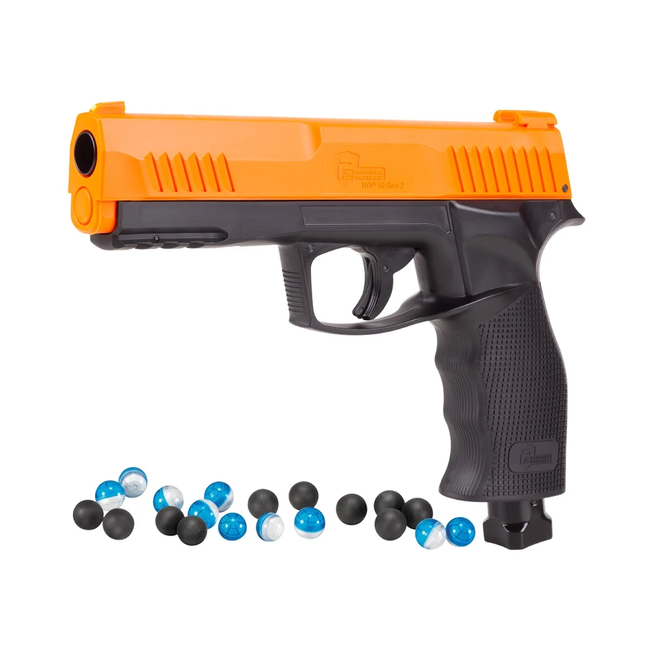
If you’re evaluating a proven .50 platform, the P2P HDP 50 Gen 2 (Full size) is a frequently considered option in this category. It’s designed around .50 caliber defensive projectiles and is often chosen for straightforward operation and home-ready ergonomics.
.68 cal launchers for home defense: strengths and tradeoffs
Why some buyers step up to .68 calibre
.68 calibre models are popular with users who want a larger projectile format and the feel of a more substantial platform. Benefits often include:
- Larger projectile size: This can translate into more impact surface area for solid projectiles and more room for certain payload styles, depending on the specific ammunition design.
- Familiarity from paintball ecosystems: Many shooters recognize .68 as the “classic” paintball size, and that familiarity can make training and handling feel more intuitive for some households.
- Platform presence: Some users simply shoot better with a larger grip/frame and more substantial feel—especially if they have bigger hands.
When shoppers search for 68 calibre models Canada, they’re often comparing kits built around defensive use rather than recreational paintball markers.
Potential downsides of .68 cal
- Bulk and maneuverability: Larger projectiles tend to require larger magazines and wider grips. In tight indoor spaces, that can matter.
- More perceived recoil and muzzle movement: This is platform- and load-dependent, but many users experience more movement with larger-calibre launches, especially in compact “pistol” formats.
- Indoor considerations with irritant/powder rounds: If your plan includes pepper/irritant style projectiles, remember that indoors you may also be affected—regardless of caliber.
A common .68 cal example to consider
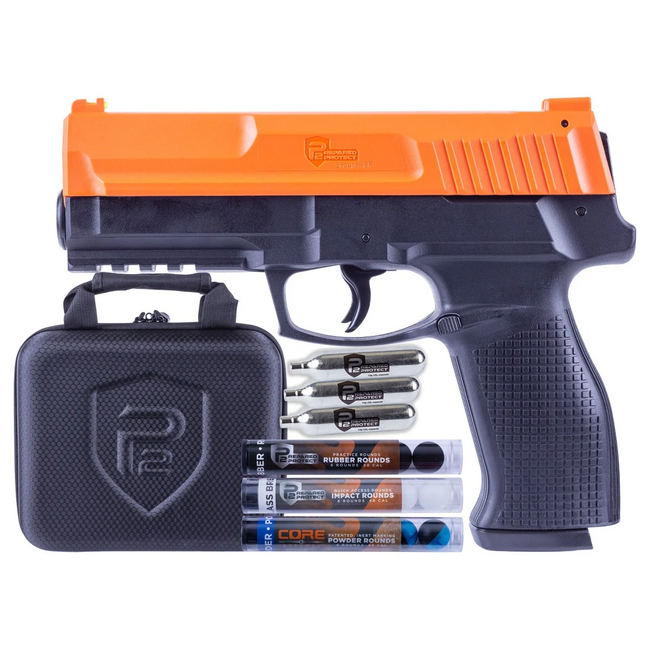
For buyers who want a turnkey .68 kit, the P2P Secure 68P Impact Defense Kit is a representative option in the category and is often compared directly against .50 cal alternatives.
Direct comparison: .50 cal vs .68 cal for typical home-defense needs
Below is a practical defense ammunition comparison and handling comparison framed around what usually matters in a real home environment.
1) Control and speed (especially for multiple household users)
- .50 cal: Often easier for a wider range of users to control, especially for smaller hands or less shooting experience. Tends to support faster, more accurate follow-up shots.
- .68 cal: Can be controllable with practice, but the platform size and recoil feel may be less forgiving for some users.
If you expect more than one person in the home to potentially deploy the launcher, ease of use is a serious advantage.
2) Projectile “presence” and impact feel
- .50 cal: Smaller diameter can still be effective, particularly when your goal is to create distance and disrupt intent. Impact feel depends heavily on projectile type.
- .68 cal: Larger diameter often feels more substantial on impact with solid projectiles and can offer larger payload capacity in some specialty rounds.
This is one of the most emotional factors in a self defense caliber comparison. The key is to match projectile type to your actual goal (deterrence, pain compliance, marking, distance creation), and to your home’s constraints.
3) Ammo variety and logistics in Canada
Ammo compatibility matters as much as the launcher. In both calibers you’ll see a mix of:
- Powder/irritant-style balls (intended to create strong sensory discouragement and/or marking, depending on formulation and legality/availability)
- Rubber or solid impact balls (intended for pain compliance and deterrence through impact)
- Training balls (often used to practice loading, aiming, and function checks)
If your plan includes keeping multiple ammo types on hand (for example, training plus defensive loads), confirm availability for your chosen caliber. For a look at commonly stocked options, browse the Self Defense Ammo collection.
For Canadian shoppers specifically researching self defense projectiles Canada, availability can change—so it’s wise to pick a caliber where you can reliably restock the projectiles you actually want to use.
4) Indoor use: what changes inside a home
Homes are enclosed spaces. That changes how less-lethal tools should be evaluated:
- Irritant/powder considerations: In a hallway, stairwell, or small room, airborne irritants can spread and affect you, your family, and pets. This is true whether you choose .50 or .68, but larger payload formats can increase the chance of lingering residue depending on the ammo.
- Backstop and property risk: Any projectile can damage drywall, glass, or valuables. Plan safe lanes, and don’t assume “less-lethal” means “won’t break things.”
- Noise and stress effects: Under stress, fine motor skills degrade. Simpler loading and consistent handling can matter more than theoretical performance.
In many homes, the “best” home defense caliber is the one that the household can deploy confidently without creating new problems (like contaminating the whole living space with irritant residue).
5) Capacity and reloads
Capacity is platform-dependent, but caliber influences magazine size and how it fits the hand.
- .50 cal: Often supports compact magazine designs that are easier to store in a bedside safe or quick-access location.
- .68 cal: Magazines can be physically larger; staging spares may require more space.
For most homeowners, the key question isn’t “What’s the maximum capacity?” but “Can I store it safely and access it quickly in the dark?”
6) Cost of ownership: launcher, ammo, and training
When comparing 50 cal vs 68 cal, include ongoing costs:
- Ammo cost and availability: Even a modest training routine adds up. You’ll practice more if it’s easy to restock.
- Consumables: Depending on platform, you may have CO2 cartridges or other consumables. Factor in what you’ll realistically keep on hand.
- Spare magazines and storage: Many people underestimate the value of having at least one spare magazine staged with a different loadout (for example, training vs defensive), where appropriate.
Choosing by scenario: which caliber fits your home?
Below are common homeowner profiles. Use them to decide which defense launcher caliber better fits your situation.
If you want the easiest handling and simplest learning curve
Lean .50 cal. For many households, the best tool is the one that gets practiced with. A .50 can be a great fit when you prioritize controllability, storage convenience, and faster competence.
If you want the largest common projectile format and a more substantial platform feel
Lean .68 cal. If your hands prefer a larger grip, and you want the feel and projectile size that many associate with classic paintball-style formats, .68 can be the right direction.
If your home has narrow hallways, tight corners, and limited safe staging space
Lean .50 cal. Compact handling and easier staging can be real advantages in smaller homes, condos, and tighter layouts.
If your plan relies heavily on impact-only projectiles (no irritant indoors)
Either can work, but be honest about training. If accuracy under stress is your priority, many users shoot .50 more precisely sooner. If you value the larger impact diameter, .68 may appeal. In both cases, choose quality projectiles and practice safe handling.
If multiple adults in the home may need to use it
Often .50 cal wins. A wider “fit” across different hand sizes and experience levels can outweigh other benefits. The most effective system is the one every responsible adult can operate reliably.
Projectile selection matters as much as caliber
Caliber is only one part of the equation. The bigger performance differences often come from which projectile you choose and how consistently your launcher feeds it.
To keep this commercial and practical, here’s how to think about ammunition types in a way that supports a realistic defense ammunition comparison:
- Training rounds: Use these to confirm function and build safe handling habits. If you never train, you’re guessing in a high-stress moment.
- Marking/powder-style: These may add visual marking and/or sensory disruption, but consider indoor contamination. Also confirm what’s available and appropriate in Canada.
- Impact (rubber/solid): Often chosen when users want to avoid airborne irritants indoors. Impact rounds still require responsible target selection and awareness of injury risk.
If you want a deeper breakdown of ball types and how they’re commonly described for Canada, the Self-Defense Ball Ammunition Guide is a helpful companion read.
Safety and responsible use: what experienced owners do differently
Less-lethal tools are not toys, and they’re not magic. Here are practices that experienced owners tend to adopt—regardless of whether they choose .50 or .68:
- They stage the launcher safely: Secure from unauthorized access, but accessible to responsible adults.
- They standardize the setup: Same storage location, same orientation, same basic routine.
- They train simple drills: Loading, acquiring sights, activating safeties, and making safe decisions under stress.
- They plan for indoors: Avoiding unnecessary irritant exposure to family members and pets, and considering where projectiles could go if they miss.
- They keep expectations realistic: The goal is to create distance and time, and to escape to safety while contacting authorities—not to “win a fight.”
Common questions from Canadian buyers
Is .68 always “stronger” than .50?
Not automatically. Larger diameter can allow different payload designs and may feel more substantial, but effectiveness depends on the specific launcher, projectile type, shot placement, distance, and whether you can make accurate follow-up shots. In many real home scenarios, controllability and accuracy can matter more than caliber alone.
Which is better for indoor home defense?
Indoor use depends more on projectile choice than caliber. If you’re concerned about airborne irritants affecting your household, consider impact-focused loads and prioritize safe lanes and training. For maneuverability and ease of use, many people prefer .50 in tight indoor spaces.
What about ammo availability in Canada?
Availability can vary. Before choosing, confirm that your preferred projectile types are easy to restock in your caliber. You can compare current options in the Self Defense Ammo collection.
Should I choose based on recoil?
Recoil and muzzle movement affect real performance—especially under stress. If you’re recoil-sensitive or want the easiest learning curve, .50 is often the safer bet. If you already shoot comfortably and prefer a larger platform feel, .68 can be a good fit.
Decision checklist: pick your caliber in 60 seconds
- Who will use it? If multiple users with varied experience: lean .50.
- Where will it be staged? If space is tight: lean .50. If you have room and want a larger frame: .68 may fit.
- What projectiles will you actually keep on hand? Choose the caliber you can reliably restock in Canada.
- Are you worried about indoor irritant contamination? Plan ammo accordingly; don’t rely on caliber to solve that.
- Will you practice? Pick the system you’ll train with. Confidence and consistency matter.
Recommended next steps (soft, practical)
If you’re close to a decision but want to confirm ammo fit and the types of rounds you can stock, start by reviewing the Self Defense Ammo selection. Then compare a representative .50 platform like the P2P HDP 50 Gen 2 (Full size) against a representative .68 kit like the P2P Secure 68P Impact Defense Kit based on the factors above: handling, staging, and projectile strategy.
When you choose between 50 cal vs 68 cal, you’re really choosing the balance you prefer between controllability and projectile size. Get that balance right for your household, and you’ll end up with a more realistic, more usable less-lethal home setup.


