
P2P vs T4E Home Defense Launchers: Choosing the Right System for Canadian Homes
In Canada, interest in less-lethal options has grown quickly—especially among homeowners who want a practical, legally mindful layer of protection. That’s where modern home defense launcher platforms come in: CO2-powered markers and “pepper gun” style launchers designed to fire training, marking, or irritant projectiles.
If you’re shopping for a pepper gun Canada option or a home defense launcher that fits Canadian households, you’ll run into two names constantly: P2P (Prepared 2 Protect) and T4E (Training for Engagement). Both are popular in less lethal Canada conversations, and both have strong product ecosystems. The best choice is less about brand loyalty and more about picking the right platform, caliber, and ammunition strategy for your home.
This guide focuses on a real-world defense launcher comparison for Canadian buyers: P2P vs T4E, .43 cal vs .50 cal vs .68 caliber defense options, CO2 formats, training value, and which models make sense for different home layouts and comfort levels.
Before you compare: what these launchers are (and aren’t) in Canada
Both P2P and T4E launchers are generally built on the “training marker” concept—tools originally popular for force-on-force training that also work with a wide variety of defensive and less-lethal projectiles. In the Canadian market, they’re commonly referred to as non lethal launcher or less-lethal tools, but it’s important to think in practical terms:
- They’re not firearms in the conventional sense, but they can still be regulated depending on velocity/energy and design. Always confirm local requirements and product specs.
- They are not magic wands: performance depends on projectile selection, shot placement, distance, and your ability to deploy under stress.
- They can still cause serious injury. Treat any home defense pistol Canada-style launcher with the same respect you’d give any weapon-like tool.
Most shoppers are really deciding between three things: (1) platform type (pistol/revolver vs long gun), (2) caliber/ammo ecosystem, and (3) how easy the system is to keep ready, maintain, and train with.
P2P vs T4E: the big-picture difference
Both systems overlap heavily, but they’re often optimized with slightly different priorities:
- P2P defense system products tend to emphasize straightforward defensive use, simple operation, and compatibility with defensive payloads (including irritant options where applicable).
- T4E Canada products are strongly rooted in training-marker heritage—realistic handling, repeatable training, and broad ammo/maintenance support. Many buyers choose T4E because they want a platform that doubles as a training marker Canada solution and a home defense launcher.
In practice, you can build an effective “home-ready” setup with either. The better question is: which system fits your home, your comfort level, and your willingness to practice?
Caliber choices: .43 cal vs .50 cal vs .68 caliber defense
Caliber is the foundation of your entire system: projectile options, felt recoil/handling, shot capacity, and intimidation factor all tend to scale with diameter. Here’s how the common options compare for Canadian buyers.
.43 caliber: compact, realistic handling, training-forward
.43 is often chosen by people who want a compact platform with handgun-like ergonomics and cost-effective practice. It can be a smart choice if your home defense plan prioritizes quick handling in tight hallways and you value realistic training reps.
- Pros: compact; often realistic controls; good for training; typically easier to store.
- Cons: smaller projectile options compared to .50/.68; may be less effective at delivering maximum impact/marker payload.
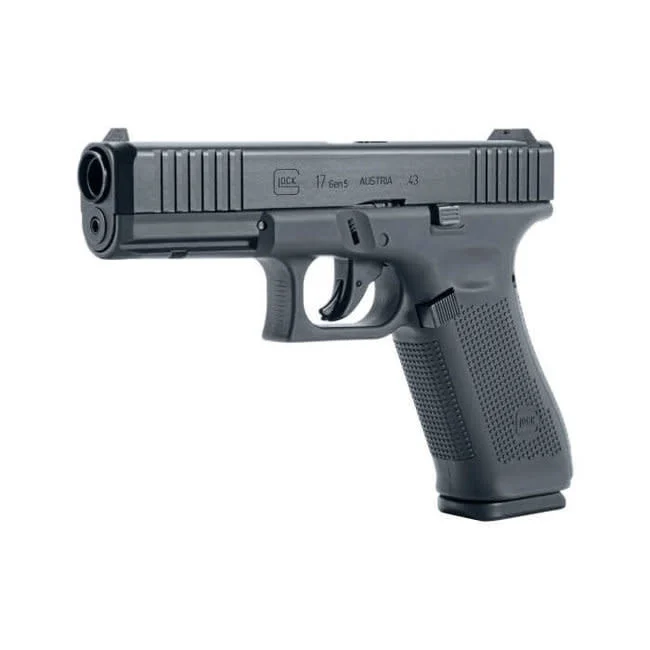
A standout example in this space is the T4E Glock G17 Gen5, which many buyers consider when they want a duty-style training marker that can also serve as a home defense pistol Canada alternative. For many households, the biggest advantage is familiarity: if you can handle it confidently and train consistently, that counts.
.50 caliber: the sweet spot for many homes
For a lot of Canadian buyers, .50 is the “Goldilocks” choice—large enough to expand your projectile selection and impact potential, but still manageable for most users. If you’re stuck on .43 cal vs .50 cal, the deciding factors are typically ammo variety and how stable you want the platform to feel when shooting quickly.
- Pros: broad defensive ammo options; good balance of control and payload; common revolver-style formats are intuitive.
- Cons: larger grip/frame than .43; still requires practice to reload and manage CO2 readiness.
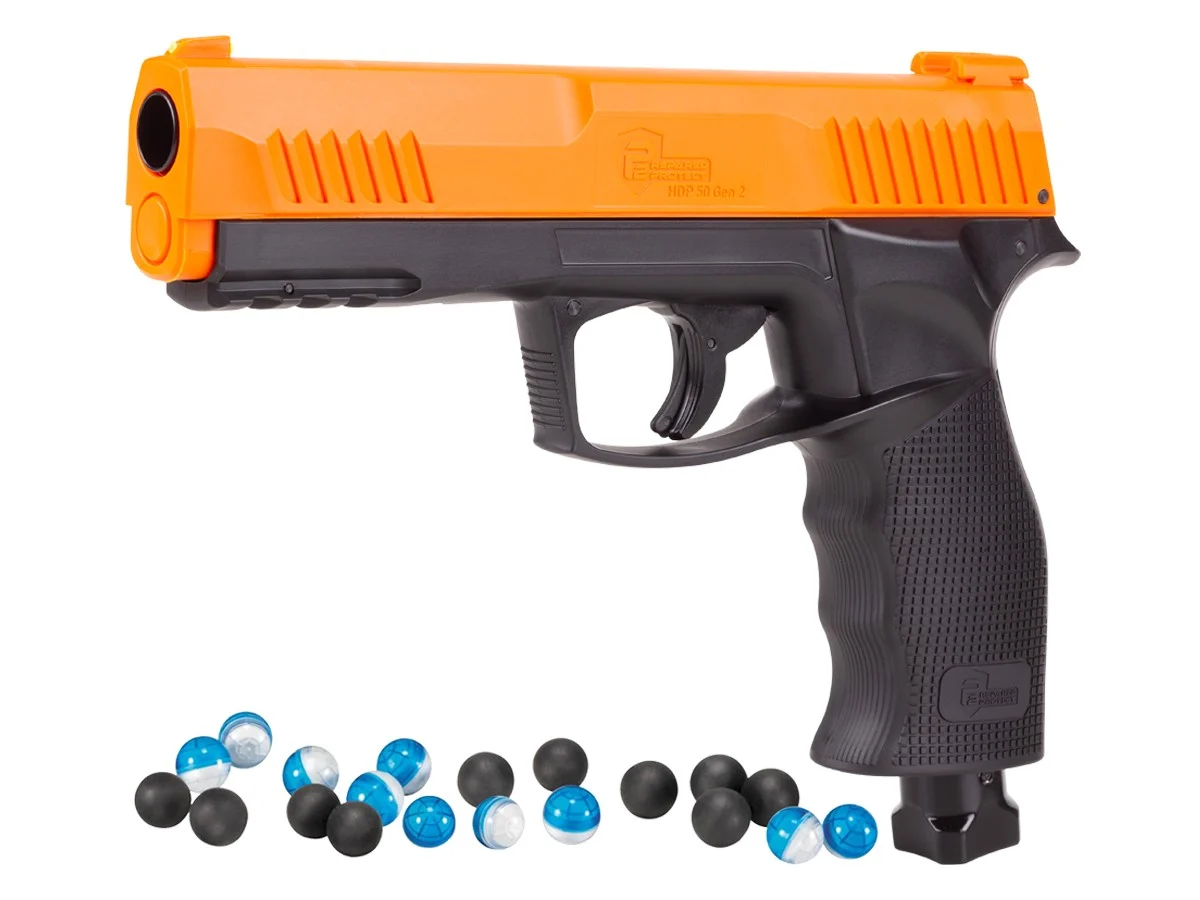
Two of the most compared models in any P2P vs T4E discussion are the P2P HDP 50 Gen 2 and the T4E TR50 Gen 2. They represent the classic CO2 defense launcher “revolver” concept: simple manual of arms, multi-shot capability, and a strong .50 caliber ecosystem.
.68 caliber defense: maximum presence, maximum payload
.68 is the largest common caliber in this category and is widely used in paintball. For home defense launcher use, it tends to appeal to buyers who want the biggest projectile options, strong deterrence value, and long-gun stability. In a defense launcher comparison, .68 often wins on payload and presence, but it can be bulkier and less convenient to stage discreetly.
- Pros: largest projectile selection; strong marking/impact potential; long guns are easier to aim under stress.
- Cons: larger, harder to store; maneuvering in tight spaces can be slower; louder and more conspicuous in handling.
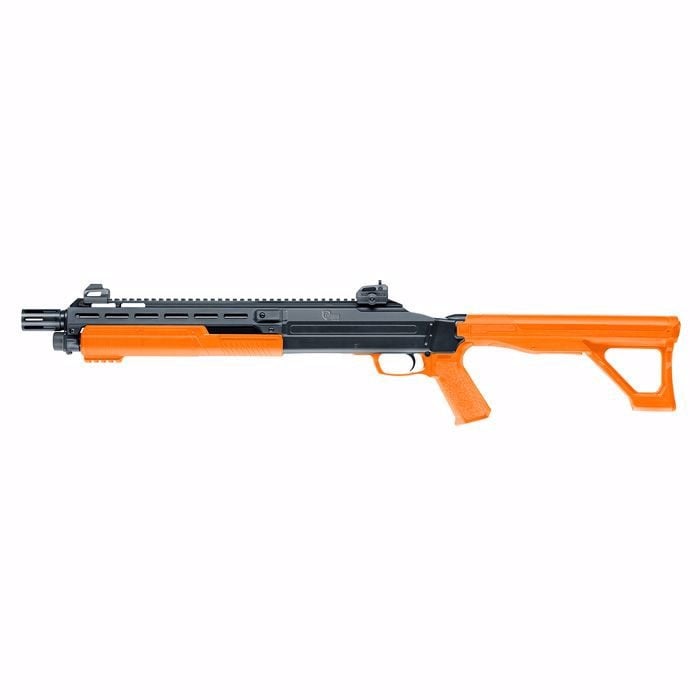
Popular .68 options include the T4E TS 68 Shotgun and the P2P HDX .68 Cal. If you prefer a more “launcher/rifle” profile for stability, the T4E TC .68 Cal is also a compelling long-gun-style platform.
CO2 defense launcher basics: what actually matters day-to-day
Most of these products are powered by CO2, typically via a 12g cartridge. As a CO2 defense launcher buyer, you’ll want to think beyond the marketing and focus on readiness and consistency.
1) Pierced vs unpierced CO2 storage
Some users prefer to keep a cartridge installed but unpierced until needed; others keep it pierced for immediate readiness (accepting that seals can slowly leak over time). Your choice should reflect your routine: how often you check the launcher, how often you practice, and how you store it safely.
2) Temperature sensitivity
CO2 performance changes with temperature. In colder environments, pressure can drop. For many Canadian households, that means performance in an unheated garage or basement may not match performance in a warm room. If you’re staging a launcher, consider where it’s stored and what temperatures it will actually experience.
3) CO2 supply management
Running out of cartridges at the wrong time defeats the purpose. If you’re building a home-ready setup, keep spare CO2 on hand and rotate it occasionally. You can find compatible supplies in the CO2 Cylinders collection.
Ammo ecosystem: the hidden deciding factor
Most buyers start by comparing the launcher itself—but the smarter move is to compare the ammunition ecosystem first. Your launcher is just a delivery system. The real capability comes from choosing the right projectiles for your goals: training, deterrence, marking, or defensive effect.
In Canada, availability and suitability matter. You may see a wide range of “defensive” rounds discussed online; not all are equally accessible, appropriate, or legal for your situation. For browsing compatible options, start with the Self Defense Ammo collection and filter by caliber.
Common ammo categories buyers consider
- Rubber balls / impact rounds: often chosen for deterrence and physical compliance potential, with significant responsibility to avoid severe injury.
- Powder/marking rounds: useful for training and post-incident identification; can be a strong fit if your plan emphasizes “create distance, escape, call police.”
- Irritant rounds (where applicable): often the reason people search “pepper gun Canada.” Evaluate very carefully—both for legal considerations and for practical risk (cross-contamination in enclosed spaces, effects on occupants, ventilation, pets, and bystanders).
Practical advice: whatever your chosen “home” loadout is, buy enough of a similar training round to practice. A launcher that feels easy at the product page can feel very different when you’re trying to operate it under stress, in low light, or one-handed.
P2P HDP 50 Gen 2 vs T4E TR50 Gen 2: the classic .50 caliber matchup
If you want a focused P2P vs T4E comparison, this is the one most Canadian shoppers are really deciding between. Both the P2P HDP 50 Gen 2 and the T4E TR50 Gen 2 sit in the same practical category: a revolver-format home defense launcher with multi-shot capability and broad .50 cal projectile support.
How to choose between them
- Ergonomics and trigger feel: Revolver-style triggers can vary in weight and smoothness. If one feels more controllable to you, that’s a major advantage for accuracy and follow-up shots.
- Sight picture and aiming confidence: Some users naturally pick up one sight system faster. At typical in-home distances, fast alignment matters.
- Maintenance comfort: Consider how easy it is to load, unload, and handle CO2 changes without fumbling.
- Ammo plan: Confirm the exact .50 ammo types you intend to use and build around that.
Both are excellent examples of what people mean by a home defense pistol Canada alternative in the less-lethal space: approachable, relatively simple, and supported by readily available accessories and projectiles.
Stepping up to .68: P2P HDX vs T4E TS 68 vs T4E TC 68
If your priority is stability and presence—especially if multiple adults in the home may need to use the device—many buyers prefer a .68 caliber defense platform.
P2P HDX .68 Cal: a defensive-minded launcher profile
The P2P HDX .68 Cal is often chosen by shoppers who want a purpose-driven home defense launcher layout with a bigger bore. For many, the appeal is straightforward: it’s a substantial platform that’s easier to point steadily than a compact pistol, especially for users who are not “handgun people.”
T4E TS 68 Shotgun: simple, direct, and highly intuitive
The T4E TS 68 Shotgun (often known for its double-barrel format) is popular for its simplicity. For some households, fewer steps and a clear manual of arms can be a major confidence boost—particularly for users who are less interested in a revolver/pistol format.
T4E TC .68 Cal: long-gun handling for aiming and control
The T4E TC .68 Cal caters to buyers who want a more traditional “rifle-like” training marker profile. In a home setting, that can mean better bracing, easier target transitions, and more precise aiming—balanced against storage size and maneuverability in tight interiors.
Where P2P Secure 68P fits: compact .68 with kit convenience
If you want .68 caliber defense capability in a more compact, packaged approach, the P2P Secure 68P is often considered by buyers who want an “all-in” starting point. The big advantage of kits is momentum: you’re more likely to actually test, practice, and validate your setup when you have the core components in one purchase.
When evaluating a kit, confirm what’s included (projectiles, CO2, carry/storage items) and decide what you’ll add immediately—most commonly extra ammo and extra CO2.
Training value: why T4E often wins “practice realism”
Many buyers underestimate training—then overestimate performance. If your goal is a home defense launcher that you can actually run well under pressure, choose the platform you’ll practice with.
T4E’s identity as a training marker Canada ecosystem matters here. Platforms like the T4E Glock G17 Gen5 are explicitly built around familiar handling and repeatable drills. If you already have experience with handgun ergonomics, or you want to build disciplined habits (grip, trigger press, reload procedure, safe staging), T4E can be a natural fit.
That said, P2P users train too—especially with .50 and .68 platforms. The key is not the logo; it’s your willingness to run a simple training plan monthly.
Choosing the right platform for different Canadian home scenarios
Below are practical “best fit” pairings. These aren’t absolutes, but they match how most customers end up using these tools in real life.
Condo or small home: prioritize compact handling
- Best fit: .43 or .50 pistol/revolver formats
- Why: easier cornering and hallway movement; simpler storage; less snag risk
- Shortlist: T4E Glock G17 Gen5 (.43), T4E TR50 Gen 2 (.50), P2P HDP 50 Gen 2 (.50)
Detached home with longer sightlines: consider .68 stability
- Best fit: .68 caliber defense long-gun or shotgun-style platforms
- Why: easier aiming and control; more payload options; strong deterrence presence
- Shortlist: T4E TC .68 Cal, T4E TS 68 Shotgun, P2P HDX .68 Cal
Multiple users in the home: choose the simplest manual of arms
- Best fit: platforms that are intuitive to load, aim, and fire
- Why: under stress, simplicity wins—especially for less experienced users
- Tip: whichever model you choose, have every intended user do a short monthly routine: check CO2, confirm ammo, practice safe presentation, and rehearse “move to safety and call police.”
What to look for when shopping: a buyer’s checklist
If your goal is a confident purchase (not just an interesting product), use this checklist to compare any P2P vs T4E option.
- Caliber availability: Are the specific projectiles you want consistently available in Canada?
- Launcher capacity and reload speed: Revolvers are easy to understand; long guns can be easier to stabilize. Decide what matters more for you.
- CO2 logistics: Do you have spare cartridges and a plan for periodic checks? (CO2 Cylinders)
- Training plan: Will you actually practice with the same platform? (This is where “training marker” DNA helps.)
- Storage: Can you store it securely from unauthorized access while keeping it accessible for your plan?
- Home layout: Tight corners and short hallways often favour compact .43/.50; open basements/garages often favour .68.
Recommended shopping paths (based on what you value)
If you want the most common, balanced home defense launcher format
Choose a .50 revolver-style platform and build your ammo and CO2 supply around it. Start by comparing the P2P HDP 50 Gen 2 and the T4E TR50 Gen 2, then select ammo from the Self Defense Ammo collection.
If you want the most training realism in a compact platform
Consider .43 caliber with a platform designed as a training marker Canada staple, like the T4E Glock G17 Gen5. This path makes the most sense for buyers who will commit to repetition and skill-building.
If you want the biggest projectile options and long-gun stability
Move up to .68 caliber defense platforms. Compare the straightforward T4E TS 68 Shotgun against long-gun handling like the T4E TC .68 Cal, or look at P2P’s defensive-oriented .68 options like the P2P HDX .68 Cal and the P2P Secure 68P.
Where to browse launchers and ammo in one place
If you’re narrowing down a purchase, it helps to compare platforms and consumables side by side:
- Self Defense Pistols (launcher platforms in pistol/revolver formats)
- Self Defense Ammo (projectiles by caliber and type)
- CO2 Cylinders (cartridges and supply)
Bottom line: the “right” system is the one you’ll keep ready and can run well
The most useful takeaway from any P2P vs T4E debate is this: performance is a system, not a single product. Your caliber choice (.43 cal vs .50 cal vs .68 caliber defense), your CO2 readiness plan, your ammo selection, and your training habits matter more than brand alone.
If you want a broadly capable, easy-to-understand home defense launcher, .50 revolver platforms like the P2P HDP 50 Gen 2 and T4E TR50 Gen 2 are the most common starting point. If you prioritize training realism and compact handling, .43 options such as the T4E Glock G17 Gen5 are worth serious consideration. And if you want maximum presence and payload variety, stepping into .68 with models like the T4E TS 68 Shotgun, T4E TC .68 Cal, or the P2P HDX .68 Cal can be the right move.
Whichever direction you choose, build the full setup—launcher, compatible rounds, and spare CO2—and then validate it with a simple, repeatable practice routine.


