
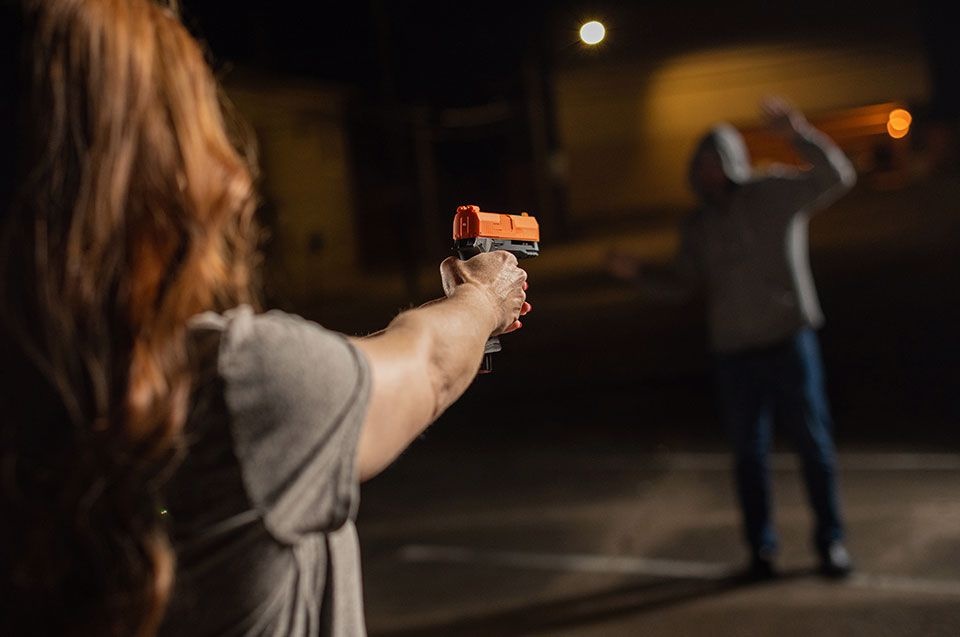
Women's Guide to Home Defense Launchers: Ergonomics, Training and Confidence
The best home defense launcher for a woman is the one sized to her hand and practised with regularly — grip circumference and trigger reach matter far more than power output. Most launchers are built around average male hands, which is why fit, not spec, is the real decision. Recoil is managed by stance, not strength. You can compare the options in our self-defense and training collection, and this guide explains how to choose one that fits and how to build confidence with it.
Key takeaways
- Fit beats power: a launcher you can rack, aim, and fire smoothly under stress outperforms a stronger one that feels awkward.
- Grip circumference and trigger reach are the two measurements that decide whether a launcher feels natural — revolvers and compacts tend to run slimmest.
- Recoil is a stance problem, not a strength problem — a firm two-handed grip and a slight forward lean absorb most of it.
- Short, frequent practice wins: ten to fifteen minutes of dry-fire a few times a week beats one long range day a month.
- Storage decides whether the launcher helps at all — quick-access and close by, not locked in another room.
What can a woman legally use for self-defence in Canada?
Pepper spray and stun guns are not lawful for civilian self-defence in Canada, which leaves a less-lethal launcher kept at home as the common legal option. These are home-defense tools, not carry items. You cannot legally carry one on your person in public, and owning one does not change how a use of force is judged afterward. This article is informational, not legal advice.
Within that frame, the choice comes down to fit and practice. Our Canadian legal guide to non-lethal home defense airguns covers the ownership rules properly, and it is worth reading before you buy anything.
How do you tell whether a launcher actually fits your hand?
Check two things: whether your fingers wrap the grip without straining, and whether your trigger finger reaches the trigger face without stretching or curling awkwardly. A grip that is too thick forces an unnatural hold, which slows your draw and pulls your shots off target under pressure.
Handle a few before you commit if you can. Revolver-format launchers and compact pistol formats generally have slimmer grips than full-size tactical models, which is why they are a common starting point for smaller hands. Compact pellet pistols are also worth picking up purely for size comparison — they serve a different purpose, but they help calibrate what a comfortable grip feels like.
Launcher formats compared for fit and handling (current pricing)
| Format | Grip and handling | Loading under stress | Examples we carry | Price (CAD) |
|---|---|---|---|---|
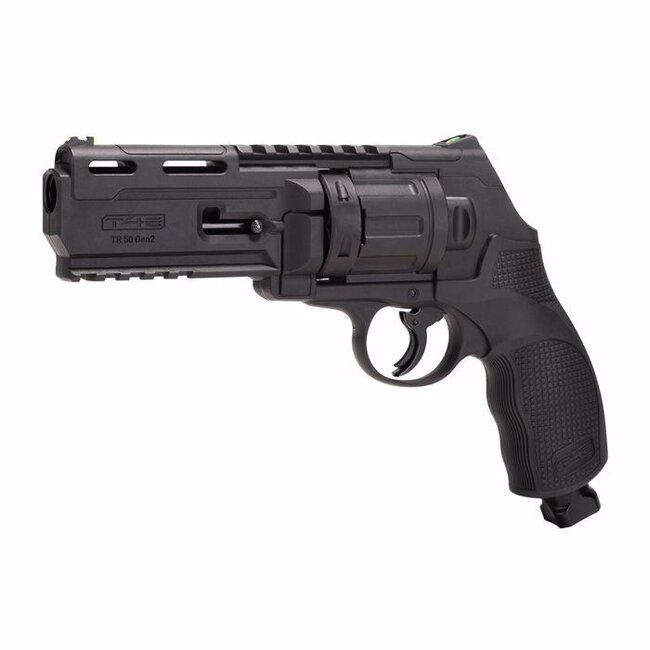
| Revolver, .50 | Slimmest grip, shortest trigger reach, CO2 sits in the grip | Simplest — fewest steps to fire | T4E TR50 Gen 2 .50 Cal Revolver | $159.99 |
| Compact pistol, .50 | Shortest overall option, easiest to hold one-handed | Straightforward, 4 rounds | P2P HDP 50 Compact w/Powder Rounds | $139.99 |
| Magazine-fed kit, .68 | Largest grip here, still light and ambidextrous | Highest capacity, 6-round magazine | P2P Secure 68P Impact Defense Kit | $279.99 |
| Practice pistol, .177 | Not a defence tool — cheap trigger time | Single-shot practice | Pellet pistols for sight and trigger practice | from $74.99 |
| Practice rounds | .50 and .68, reusable | — | T4E Rubber Balls .50 Cal 10ct; Rubber Balls .50 Cal 250ct; Rubber Balls .68 Cal 100ct | $8.50–35.00 |
| CO2 and spare mags | Keeps a session going | — | Umarex CO2 12g 12ct; Spare 6-Shot and Extended 9-shot Magazines | $11.85–37.95 |
How do you manage recoil without upper body strength?
Recoil is controlled by grip and stance, not arm strength: lock your wrists, take a firm two-handed hold, and lean your weight slightly forward. That combination keeps the muzzle from rising and spreads the impulse into your frame instead of your shoulders.
Use a staggered stance with one foot slightly ahead of the other for a stable base. Practise it dry, with nothing loaded, until it stops feeling deliberate. Most new shooters find the recoil far less of an issue than they expected once the stance is right — the perceived kick usually comes from an unstable platform, not the launcher.
What does a practical training routine look like?
Short and frequent beats long and occasional. Ten to fifteen minutes of dry-fire at home, a few times a week, trains grip, trigger control, and target acquisition without the cost or logistics of a range trip. Live rounds then confirm what the dry practice built.
A workable beginner progression:
- Dry-fire grip and trigger practice at home, several short sessions a week.
- Static target practice at close range, 2 to 3 metres, with live rounds.
- Practice from a seated or woken-up position, since real incidents rarely start with you standing ready.
- Add a timer once your accuracy is consistent, not before.
- Repeat the full sequence monthly to keep it current.
Cheap practice rounds are what make this sustainable. A 10-count of .50 rubber balls starts at $8.50 and a 12-count of Umarex 12g CO2 runs $11.85, so a practice session costs a fraction of what defence-rated rounds cost, and you can shoot volume without burning through the rounds you keep loaded. Stock both from the self-defense ammo collection.
Storage that is both secure and actually reachable
A launcher locked in a case across the house does not function as a defense tool. Quick-access storage means a lock box within reach of where you sleep, with rounds beside it — secure enough for a household with children or guests, fast enough to matter at 3am.
Discretion matters to a lot of buyers too. A soft case that does not announce itself, or a small lock box that reads as a drawer unit, keeps the launcher out of sight without adding steps. Whatever you choose, time yourself opening it. More than a few seconds and the storage is working against you.
Frequently asked questions about home defense launchers for women
Are less-lethal launchers hard to use with smaller hands?
Not if you choose for fit. A revolver format or a compact pistol has a slimmer grip and a shorter trigger reach than a full-size model. Handling two or three options before buying tells you more than any spec sheet will.
Do I need upper body strength to handle the recoil?
No. A correct two-handed grip and a stable staggered stance do the work. Most of the kick people describe comes from an unstable stance rather than the launcher itself.
How often should I train with a home defense launcher?
Short weekly sessions, not occasional long ones. Ten to fifteen minutes of dry-fire a few times a week keeps grip and trigger control sharp, with live rounds monthly to confirm it.
Where is the safest place to store a launcher at home?
A quick-access lock box near where you sleep, not a safe in another room. The goal is storage that is secure against curious hands and openable in seconds by you.
Is a .68 calibre launcher too much for a smaller shooter?
Not inherently, though .68 platforms are generally larger and heavier than .50 ones. If grip size or weight is your constraint, a .50 revolver or compact pistol is usually the better fit. Our .50 vs .68 calibre comparison works through the trade-off.
Where to start?
Pick for fit first, then commit to a routine you will actually keep: handle two or three launchers, choose the one you can operate smoothly, and set up quick-access storage the same day it arrives. Confidence comes from repetition, not from the price of the tool.
To shop online, start with these collections:
- Self-defense and training category — every less-lethal platform and round we carry.
- Self-defense pistols — compact and full-size launcher formats.
- Self-defense ammo — training rounds and defensive rounds, kept separate.
- Spare magazines — a reload you do not have to load first.
- Pellet pistols — inexpensive platforms for pure trigger-time practice.
If you buy one thing alongside the launcher, make it a bulk bag of practice rounds — the launcher you shoot often is the one you will trust. For platform background, our complete guide to non-lethal self-defense pistols and our first self-defense training kit guide are both good next reads. For where the launcher sits in a wider plan, see our layered home security strategy guide, and our guide to paintball and training uses covers getting cheap practice out of the same platform.


