
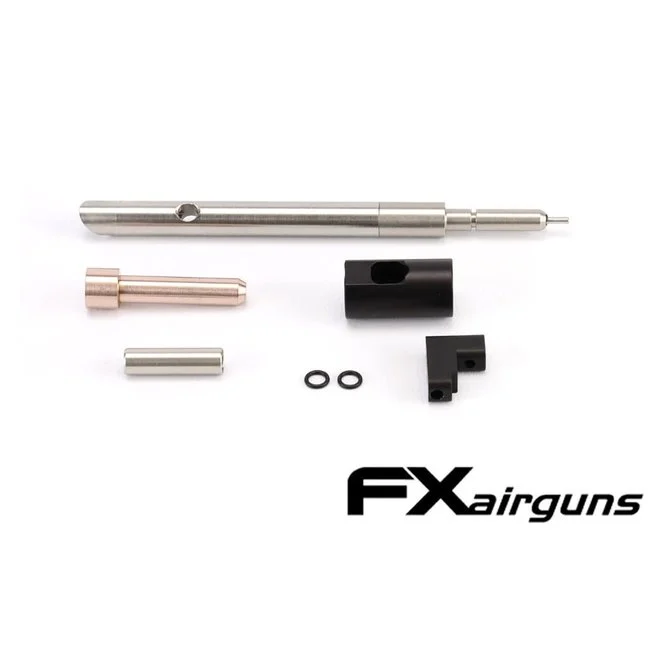
FX Impact Slug Power Kits: Pellets to Long-Range Slugs
A slug power kit retunes an FX Impact for heavier projectiles by changing three things: hammer mass, valve dwell, and how the projectile seats in the barrel. Slugs weigh more than pellets of the same calibre, so they need more air behind them and a different seating depth to shoot accurately. The stock tune is built around pellets. You can find slug ammunition and tuning parts in our FX Impact accessories collection, and this guide explains what changes inside the rifle and whether you actually need it.
Key takeaways
- Three variables do the work: a heavier hammer, a valve that stays open longer, and controlled seating depth for the slug.
- Most Impact owners do not need a kit — if you shoot moderate-weight slugs at a sensible regulator setting and your groups are tight, leave it alone.
- Airflow is the bottleneck once you go heavy: more hammer strike is wasted if the transfer port cannot pass the air.
- Barrel liner matters as much as power — slugs want a liner with a twist rate and bore suited to them, not just more velocity.
- Every change interacts, so re-chronograph and re-tune after any part of this. Treat it as one job, not five separate ones.
What does a slug power kit actually change?
It increases hammer mass, reduces valve return spring tension so the valve stays open marginally longer, and gives you control over how deep the slug seats before firing. More hammer energy plus longer valve dwell means more air passes per shot, which is what a heavier projectile needs to reach a useful velocity.
None of that touches the regulator directly, which is the part people find counterintuitive. The regulator sets the pressure available to the valve; the hammer and valve decide how much of it actually gets used per shot. A slug kit works on the second half of that equation.
Why do slugs need a different tune than pellets?
Because mass and drag behave differently. A slug of the same calibre is heavier than a diabolo pellet and does not use air resistance to stabilise. It relies on spin from the rifling instead, and it needs meaningfully more energy to reach the velocity where it flies well.
Underpowering a slug is the classic failure. It leaves the muzzle too slowly, never stabilises properly, and produces groups that look like a barrel problem. Overpowering it is also possible and wastes air for no accuracy gain. There is a velocity window per slug weight, and finding it is the actual job — the kit just gives you the range to reach it.
What each slug tuning variable controls
| Variable | What it controls | Symptom when it is wrong | Adjust when |
|---|---|---|---|
| Hammer mass and spring | How hard the valve is struck | Velocity ceiling too low for the slug weight | You cannot reach target velocity at a sane reg setting |
| Valve dwell | How long air flows per shot | Inconsistent velocity, high spread | Velocity is close but the spread is wide |
| Transfer port | Rate air reaches the barrel | Hammer changes stop producing gains | You have hit a plateau despite more hammer energy |
| Seating depth | Where the slug sits before firing | Flyers and inconsistent groups at good velocity | Velocity is right but accuracy is not |
| Barrel liner | Spin rate and bore fit | No tune fixes the groups | You are committing to slugs long term |
| Regulator setpoint | Pressure available per shot | Shot curve drifts across a fill | After any hammer or port change |
Do you actually need a slug power kit?
Probably not, unless you are running heavy slugs at high regulator pressure and finding the rifle cannot get there. If you shoot lighter slugs at a moderate setpoint, get the velocity you want, and your groups are already where you need them, the stock tune is doing its job — changing it will cost you time and a working setup.
The honest test is this: chronograph what you have. If velocity is consistent and accuracy is good, you have no problem to solve. If you have already raised your regulator as far as sensible and still cannot reach the velocity your slug weight needs, or your spread is stubbornly wide, that is when the hammer and valve side becomes the answer.
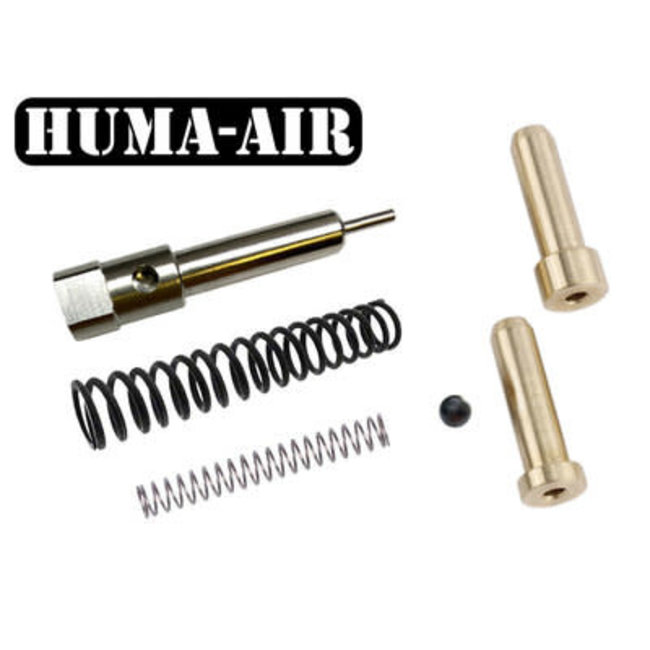
If you get there, the Huma-Air FX Impact Slug Power Kit at $79.99 bundles the parts that address all three variables in the table above — a power tune hammer spring, a valve return spring, a 6.9 g and 8.5 g hammer weight set, an NBR buffer ball, and a high-flow pin probe. It is currently on a four to six week lead time, so order ahead of the season rather than mid-tune.
How does airflow limit a heavy tune?
Hammer and valve changes only help if the air can physically reach the barrel fast enough. Past a certain point, striking the valve harder produces no more velocity because the transfer port has become the restriction. That is the plateau a lot of people mistake for needing an even heavier hammer.
Diagnosing it is straightforward: if successive hammer or spring increases stop moving your velocity while air consumption keeps climbing, the port is the bottleneck. Flow parts and internal components for the platform sit in the custom parts and tuning collection, with FX-specific parts grouped inside it. Barrel liners and kits are under barrel kits and liners.
Tuning after installation: a working order
Change one thing at a time and chronograph after each one. The single biggest cause of a tune that will not come together is three simultaneous changes and no data about which one helped.
- Fit the kit completely before testing anything. Partial installs produce misleading numbers.
- Re-check your regulator setpoint, since a kit changes how much air the valve releases at a given pressure.
- Chronograph a full magazine with your actual slug of choice. Record average velocity and spread, not just a couple of shots.
- Adjust seating depth in small increments. This affects accuracy far more than velocity, so watch groups rather than the chronograph here.
- Confirm consistency across a full fill, not a short string. A tune that holds for ten shots and drifts by forty is not finished.
Match your ammunition to the tune while you are at it. The slugs collection covers the calibres we stock, and settling on one slug weight before you start tuning saves a great deal of repeated work. A digital manometer makes the regulator side of this measurable rather than guessed.
Frequently asked questions about FX Impact slug tuning
Do I need a slug power kit to shoot slugs at all?
No. Plenty of Impact owners shoot slugs successfully on the stock tune, particularly at moderate weights and regulator pressures. The kit becomes relevant when you are pushing heavier slugs than the stock valve dwell supports comfortably.
Can I install a slug power kit myself?
Many owners do, though it involves working inside the action and is more involved than fitting a rail. If you are not confident, we perform this work for customers rather than leaving you to guess.
Will a heavier hammer damage anything?
Used within the platform's intended range, no. Pushing far beyond it stresses the valve and increases air consumption for diminishing returns, which is why chronograph data matters more than simply fitting the heaviest option available.
What calibre works best for slugs in the Impact?
.22 and .25 are the most common slug calibres among Canadian Impact owners, with .30 used for heavier work. Match your barrel liner to the calibre and slug weight rather than assuming a bigger calibre is automatically better.
Does a slug tune reduce my shot count?
Yes, usually noticeably. More air per shot means fewer shots per fill, which is worth planning for — our guide to FX Impact bottle vs tube configuration covers how reservoir choice changes that maths.
Where to start?
Chronograph before you buy anything. Establish your current velocity and spread with the slug you actually intend to shoot, then decide whether you have a power problem, a flow problem, a seating problem, or no problem at all. Most people discover it is one of the last two.
To shop online, start with these collections:
- FX Impact accessories — Impact-specific parts and hardware.
- Slugs — the projectiles the whole tune is built around.
- Custom parts and tuning — regulators, flow parts, and internals.
- Barrel kits and liners — liner options matched to slug work.
- Regulators — for stable pressure under a heavier tune.
If you are new to slugs, buy two or three slug weights before you buy a single tuning part, because the cheapest accuracy gain available is usually finding the projectile your existing barrel already likes. Our FX Impact M4 tuning guide covers the broader tuning principles, and our guide to Saber Tactical upgrades for the FX Impact is a good next read if you are building out the rifle at the same time.


