
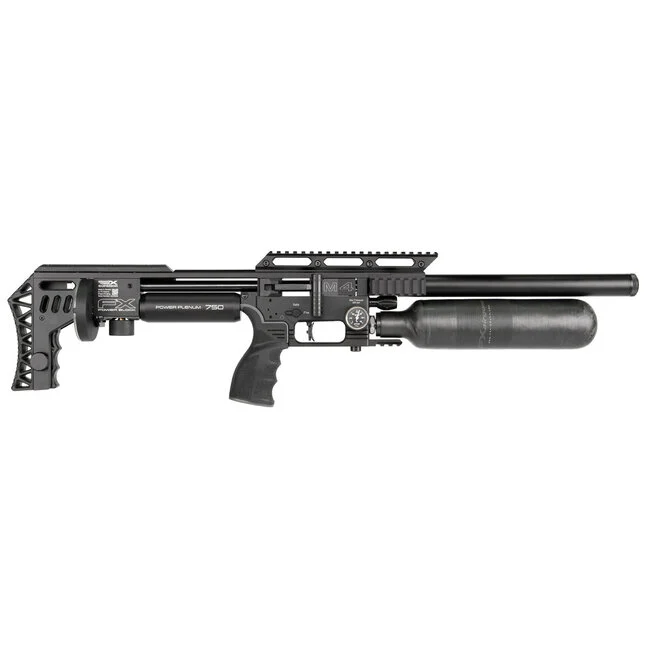
FX Impact Bottle vs Tube: Choosing Your Air Reservoir
An FX Impact bottle setup carries its air in a removable cylinder under the barrel, while a tube setup holds it inside the rifle body — the bottle gives you more air and a swappable reservoir, the tube gives you a slimmer, rest-friendly profile. Both run the same valve, regulator, and trigger group, so neither is more accurate than the other. The decision is about balance and shot count. You can see the parts for either route in our FX Impact accessories collection, and this guide explains which configuration suits how you shoot.
Key takeaways
- Shot count favours the bottle — a larger removable cylinder holds more air than the in-body tube, which means fewer fills across a long session.
- Handling favours the tube: a cylindrical body sits deeper and more securely in a bipod or tripod yoke than a wider bottle does.
- Accuracy does not change between formats — velocity and consistency come from the valve and regulator, which are shared.
- Swapping is a parts change, not a new rifle, so you can test one configuration and move to the other later.
- Re-zero after a swap: forward weight shifts your natural point of aim even though nothing about the shot cycle changed.
What is the real difference between a bottle and a tube FX Impact?
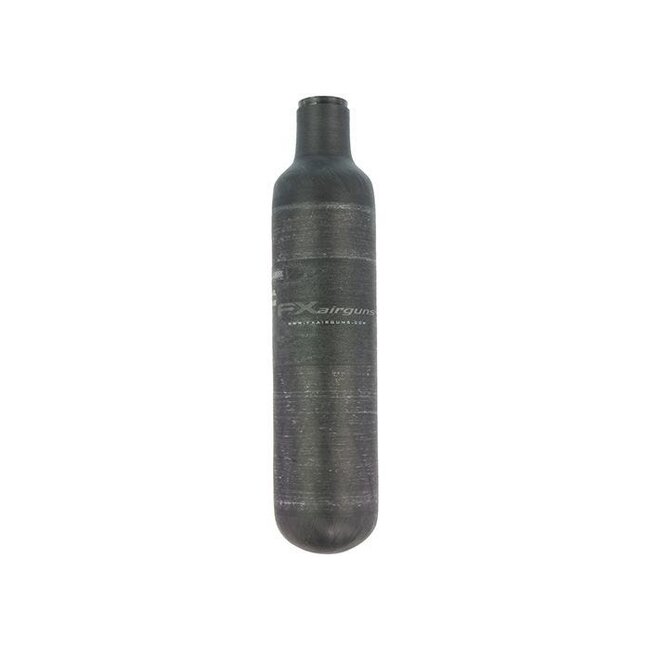
The difference is where the compressed air lives and whether you can remove it. A bottle Impact mounts a separate air cylinder beneath the barrel, held by a valve that threads into the rifle. A tube Impact stores the same air inside the rifle's own body, which makes the reservoir structural rather than a component you unscrew.
That single distinction drives everything else. A removable bottle can be swapped for a larger or smaller one depending on the day — lighter for a walked-up hunt, larger for a bench session. A tube cannot, because the reservoir is part of the rifle. What the tube gives back is a narrower, more conventional profile.
Which configuration gives you more shots per fill?
The bottle, in almost every comparison — a larger removable cylinder simply holds more air than the in-body tube on the same platform. How much more depends on the bottle size you fit and the regulator setpoint you run, since a higher setpoint spends more air per shot regardless of where that air is stored.
Treat shot count as a function of three things: reservoir volume, fill pressure, and how hard you are tuned. Chasing shot count by fitting a bigger bottle while also raising your regulator pressure for heavy slugs can leave you roughly where you started. If you want to track this properly rather than guess, a digital manometer takes the estimation out of it, and we stock FX's own gauge for the platform.
FX Impact bottle vs tube: what actually changes
| Characteristic | Bottle | Tube |
|---|---|---|
| Air volume per fill | Higher, and scalable by fitting a different bottle | Fixed by the rifle body |
| Reservoir swappable | Yes — unscrews from the valve | No |
| Profile and bipod fit | Wider; usually wants a clamp-style rail adapter | Narrower; seats deeper in a yoke |
| Balance | Weight concentrated under the barrel | Spread along the body, more sporter-like |
| Accuracy and consistency | Unchanged — same valve and regulator | Unchanged — same valve and regulator |
| Best fit | Long sessions, field target, slug tunes that drink air | Bench and rest work, carry-friendly builds |
How does each configuration handle in the field?
Bottle guns concentrate weight under the barrel, which many shooters find livelier to mount and swing offhand. Tube guns balance more like a conventional rifle and settle more predictably on a bag or bipod. Neither balance point is wrong — it tracks how much of your shooting happens standing versus supported.
The practical wrinkle is support gear. A tube's narrow cylindrical profile drops into a tripod or bipod yoke naturally, while a bottle's larger diameter often wants a clamp-style adapter to give you a proper mounting surface. That is a solvable problem rather than a reason to avoid the bottle, and the bipods, slings and rests range covers the support side once you have decided.
What does swapping between bottle and tube involve?
It is a parts swap on the same rifle, not a rebuild. You are changing the reservoir and its valve, plus whatever rail adapter your support setup needs. The action, barrel, and regulator stay where they are.
- Confirm what your Impact currently runs, and which model generation it is — fitment is model-specific, so check the part is listed for your exact rifle.
- Source the bottle and the matching valve. A bottle needs a valve threaded to suit it, and FX sells bottles with the valve already fitted, which is the simpler route.
- Add a clamp-style rail adapter if you shoot off a bipod or tripod, so you keep a usable mounting point on the new profile.
- Check the maximum fill pressure for the assembly you have fitted before your first fill, since ratings differ between reservoirs.
- Re-zero. Velocity has not changed, but your hold and natural point of aim probably have.
The bottles and clamp adapters we carry for the platform are below.
FX bottles and bottle-clamp adapters we carry
| Part | What it is for | Price (CAD) |
|---|---|---|
| FX 300 BAR Bottle w/Valve | Factory bottle with the valve already fitted, the simplest route into a bottle setup | $439.99 |
| FX 480cc Carbon Fiber Bottle w/Valve | Larger capacity, carbon fibre to keep the weight penalty down | $399.99 |
| FX 300cc Carbon Fiber Bottle w/Valve | Smaller and lighter, for carrying all day over maximum shot count | $389.99 |
| Saber Tactical 60mm Arca Bottle Clamp | Arca mounting surface clamped to a 60mm bottle | $99.99 |
| Saber Tactical 60mm Bottle Clamp Rail Adapter | Picatinny mounting point on a bottle-configured rifle | $87.00 |
| Buddy Bottle Protective Sleeve | Protects the bottle finish, cheapest thing you will buy for it | $10.00 |
Fill gear and fittings for either configuration sit in the PCP accessories range, with tanks specifically under air tanks. For the wider FX parts range, the FX Airguns accessories collection is the place to browse.
Which setup fits your shooting style?
Choose the bottle if you shoot long strings, run a thirsty slug tune, or want the option of changing reservoir size by season. Choose the tube if most of your shooting happens off a rest and you value a trim, conventional profile.
Imagine a shooter who walks up small game in the autumn and shoots bench indoors over winter. A bottle suits the autumn use, where fewer fills and a swappable cylinder matter, while a tube or a bipod-adapted bottle suits the winter bench work. The Impact platform does not force one answer for the whole year, which is most of why people buy it. If your tune is heading toward heavy slugs, read our guide to FX Impact slug power kits before you settle on a reservoir, since air demand per shot changes the calculation.
Frequently asked questions about FX Impact air reservoirs
Does switching from tube to bottle affect accuracy?
Not directly. Velocity and shot-to-shot consistency come from the valve and regulator, which are the same in both configurations. What changes is balance, which can affect your hold until you adjust and re-zero.
Is a bigger bottle always better?
No. A larger bottle gives more shots per fill but adds weight under the barrel. Hunters who carry all day often prefer a smaller bottle or a tube, and accept more frequent fills in exchange.
Will a bottle setup still work on a bipod?
Yes, though a bottle's wider diameter usually wants a clamp-style rail adapter to give you a flat Picatinny or Arca mounting surface. Plan for that adapter as part of the swap rather than an afterthought.
Do bottle and tube guns need different cases?
Usually not, since overall rifle length changes little between configurations. If you are fitting a large bottle, check your case's internal depth before assuming it fits.
Where to start?
Decide how you shoot before you buy hardware: bottle for long strings and seasonal flexibility, tube for a trim rifle that lives on a rest. Then confirm the part you want is listed for your exact Impact generation, because fitment is where most of these purchases go wrong.
To shop online, start with these collections:
- FX Impact accessories — reservoir parts, rails, and Impact-specific hardware.
- FX Airguns accessories — the full FX accessory range.
- PCP accessories — fill gear, hoses, and fittings.
- Air tanks — to keep a higher-capacity rifle topped up.
- Regulators — to fine-tune air delivery alongside a capacity change.
If you are undecided, shoot your current configuration for a few sessions with a chronograph and a note of how many fills you actually needed — the answer is often that your reservoir was never the limiting factor. For the ergonomics and mounting side, our guide to Saber Tactical upgrades for the FX Impact covers rail adapters in detail, and our FX Impact M4 tuning guide is a good next read.


