
T4E Calibre Guide for Canada: .43, .50, and .68 Cal Explained
The Umarex T4E line is available in three calibres — .43, .50, and .68 cal — and your calibre choice determines which models you can buy, which ammunition types are compatible, how much energy each shot delivers, and what your ongoing cost to run the platform will be. Calibre is fixed at purchase and cannot be changed; choosing the wrong one means buying a second launcher to get the capability you need. This guide maps every T4E calibre to its available models, ammunition range, CO2 use, and the scenarios each calibre handles best. Browse all current options in our T4E pistol collection.
What is the difference between .43, .50, and .68 cal in the T4E line?
Calibre refers to the internal diameter of the launcher's barrel — and in the T4E context, it determines the physical size of the projectile, the energy delivered on impact, the ammunition types available, and the specific models you can choose from. Larger calibres generally deliver more energy per shot, support a wider range of round types, and cost more per round to run.
| Calibre | Available T4E Models | Power Source | Effective Range | Ammo Types | CO2 Use | Best Use Case |
|---|---|---|---|---|---|---|
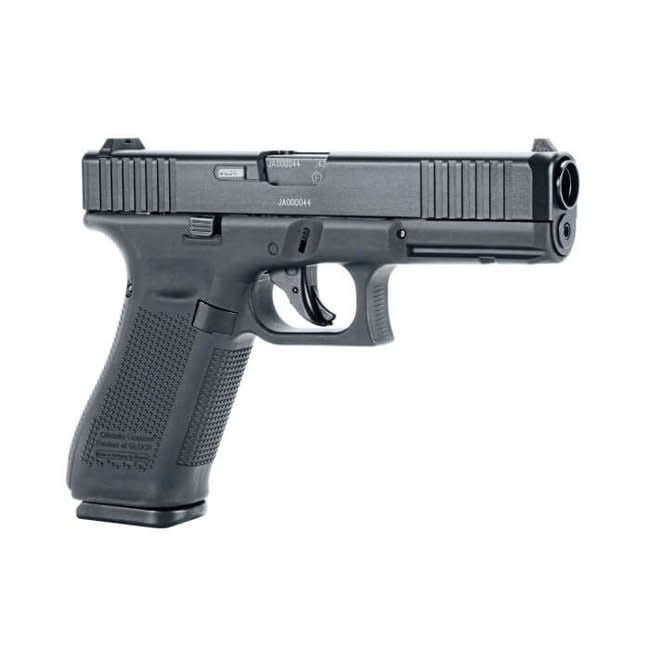
| .43 cal | T4E Glock G17 Gen5 | 1×12g CO2 | 15–20m | Rubber, paint, powder | 8–10 shots/cartridge | Compact carry, indoor CQB training |
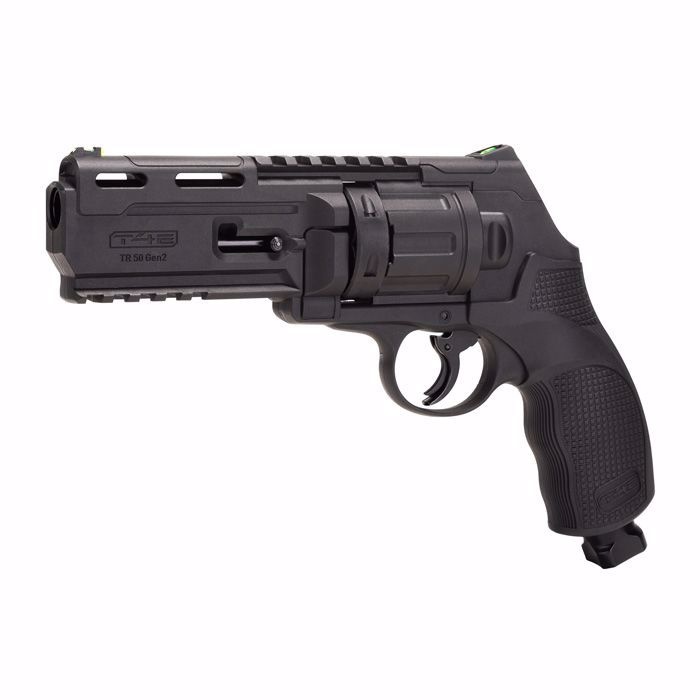
| .50 cal | T4E TR50 Revolver, P2P HDP 50 | 2×12g CO2 | 20–25m | Rubber, paint, powder, pepper | 10–12 shots/fill | Balanced training + defence |
| .68 cal | T4E HDX, T4E TC 68, P2P Secure 68P | 2×12g CO2 | 15–20m | Rubber, paint, powder, pepper, First Strike | 8–10 shots/fill | Maximum impact, home defence |
One number worth noting: the .50 cal platforms achieve a slightly longer effective range (~20–25m) than the .68 cal platforms (~15–20m) despite their smaller projectile size. This is because .50 cal projectiles have a better ballistic coefficient at this scale — they shed velocity more slowly over distance. The .68 cal trades range for impact energy. For most home defence scenarios, neither difference is practically significant given that both calibres are designed for close-quarters use.
What is the most powerful T4E calibre?
By impact energy, .68 cal is the most powerful T4E calibre — a .68 cal rubber ball or kinetic round delivers more joules on target at close range than the equivalent .43 or .50 cal round, primarily because it carries more mass. The T4E HDX .68 cal and T4E TC 68 both deliver substantially more energy per hit than the T4E Glock G17 Gen5 at the same distance.
That said, "most powerful" does not automatically mean "best for your use case." The .68 cal's higher energy comes with trade-offs: higher per-round cost, reduced shot count per CO2 fill (8–10 shots vs 10–12 for .50 cal), and a slightly shorter effective range. For buyers whose primary concern is impact force at close quarters — a bedroom or hallway scenario — .68 cal is the correct choice. For buyers who want deterrence at 20+ metres, the .50 cal's range advantage is relevant.
The .43 cal delivers the least energy per shot, but that is not a reason to dismiss it. For training — where you are running 50–100 rounds per session at rubber ball targets — the lower energy means less wear on your target setup and lower per-round cost. Training frequency matters more for skill development than projectile energy. The T4E Glock G17 Gen5 .43 cal is the right choice when training volume is the priority.
Can a .43 cal T4E shoot pepper balls?
No — the .43 cal T4E Glock G17 Gen5 is not compatible with pepper ball ammunition. Pepper balls are only available for .50 and .68 cal platforms. If pepper ball capability is a requirement for your setup, your calibre choice is either .50 cal (T4E TR50 revolver or P2P HDP 50) or .68 cal (T4E HDX, T4E TC 68, P2P Secure 68P).
This is one of the most consequential constraints in T4E calibre selection. Many buyers start with the .43 cal Glock for its lower price and training economy, then discover after purchase that they cannot add pepper balls to their ammunition rotation. If deterrence capability — beyond pure impact force — is part of your home defence plan, start at .50 or .68 cal.
For a full breakdown of what each round type does and which calibres support them, see our self-defence ammunition guide for Canada — it covers ammo chemistry, use case, and sourcing for each round type in detail.
What ammunition is available for each T4E calibre in Canada?
Ammunition availability and cost vary meaningfully across the three calibres — and because calibre is fixed at purchase, your long-term running cost is determined the moment you choose your launcher. The table below maps every major T4E-compatible round type to the calibres that support it, with approximate Canadian per-round pricing for the most common training round (rubber balls).
| Ammo Type | .43 Cal | .50 Cal | .68 Cal | Notes |
|---|---|---|---|---|
| Rubber balls | ✓~$0.30–0.50/rnd | ✓~$0.50–0.80/rnd | ✓~$0.80–1.20/rnd | Standard training round for all calibres |
| Paintballs | ✓ | ✓ | ✓ | Marking drills; standard paintball stock compatible |
| Powder balls | ✓ | ✓ | ✓ | Low-impact chalk/powder marking |
| Pepper balls | ✕ | ✓ | ✓ | OC irritant rounds; deterrence use only |
| First Strike rounds | ✕ | ✕ | ✓.68 cal only | Fin-stabilised for extended range accuracy |
The per-round cost gap matters at volume. If you are running 100-round training sessions once per week, the difference between .43 cal (~$35–50/session) and .68 cal (~$80–120/session) in rubber ball cost alone adds up to $2,300–$3,640 per year at weekly frequency. Buyers who train regularly and want to keep ammunition costs manageable should start at .43 cal for training and consider a separate .68 cal platform staged for defence — rather than running all training through a .68 cal launcher. Browse T4E ammunition by calibre to compare current pricing.
What is the range difference between .43, .50, and .68 cal?
The .50 cal platforms (T4E TR50, P2P HDP 50) have the longest effective range at approximately 20–25 metres; both .43 and .68 cal platforms are effective to approximately 15–20 metres under controlled conditions. Beyond these ranges, accuracy and energy delivery drop significantly for all three calibres — these are close-quarters platforms, not long-range deterrents.
The slightly longer range of .50 cal is a genuine practical advantage in certain scenarios: a longer hallway, a garage or driveway approach, or an open-plan ground floor where a threat might be further than typical bedroom distances. If your home layout involves longer sight lines, the .50 cal's range edge is worth factoring in.
For the majority of home interior scenarios — rooms, hallways, stairwells — the range difference between .43, .50, and .68 cal is not operationally significant. Most engagements in residential settings happen within 5–10 metres. At those distances, all three calibres perform within similar effective envelopes. Range should be a secondary factor in calibre selection unless your specific environment genuinely demands the 20–25m capability.
How many CO2 cartridges does each T4E calibre use?
The .43 cal T4E Glock G17 Gen5 uses a single 12g CO2 cartridge per fill; all .50 and .68 cal T4E platforms use two 12g CO2 cartridges per fill. Shot count per fill varies by calibre, platform condition, and ambient temperature.
- .43 cal (T4E Glock G17 Gen5): 1×12g CO2 cartridge → approximately 8–10 shots per fill. Single-cartridge format makes it the most economical to run on CO2 costs as well as per-round costs.
- .50 cal (T4E TR50, P2P HDP 50): 2×12g CO2 cartridges → approximately 10–12 shots per fill. The slightly higher shot count per fill relative to .68 cal reflects lower per-shot gas consumption at the smaller projectile size.
- .68 cal (T4E HDX, T4E TC 68, P2P Secure 68P): 2×12g CO2 cartridges → approximately 8–10 shots per fill. The larger projectile requires more gas per shot, reducing shot count versus the .50 cal on the same dual-cartridge fill.
Cold weather reduces CO2 efficiency across all calibres. At 0°C, you can expect approximately 20–30% fewer shots per fill compared to a room-temperature baseline. In Canadian winters, this is a real operational consideration for outdoor training sessions. If you are staging a .68 cal launcher for home defence, keep it in a temperature-controlled environment — CO2 canisters stored in a cold garage will perform significantly worse in an urgent deployment than canisters stored indoors.
For a broader comparison of how these platforms behave in real-world conditions, our .50 vs .68 cal platform comparison covers seasonal performance and CO2 management in more detail.
Which T4E calibre is best for your situation?
The right calibre is the one that matches your primary use case without paying for capability you will not use. Here is a direct framework based on the most common buyer scenarios.
- Training at volume, budget-conscious:.43 cal T4E Glock G17 Gen5. Lowest entry price (~$149), lowest per-round cost (~$0.30–0.50), single-cartridge CO2, and a realistic Glock form factor for handling drills. Accept that pepper balls are not available at .43 cal.
- Both training and deterrence capability from one platform: .50 cal — the T4E TR50 revolver or the P2P HDP 50 Gen 2. Pepper ball capable, 20–25m effective range, manageable per-round cost (~$0.50–0.80 for rubber), and the most economical CO2 consumption per fill in the T4E range (10–12 shots).
- Maximum impact force and full ammunition range: .68 cal — the T4E HDX .68 cal or T4E TC 68. Highest energy per shot, First Strike round compatibility, and the widest round selection. Accept the higher per-round cost and slightly lower shot count per fill.
- All-in-one defence setup, no component sourcing: P2P Secure 68P Impact Kit at .68 cal — launcher plus rounds in a single package, removing the need to source ammunition separately for first-time buyers.
- Two-platform approach (train cheap, stage hot): Many experienced buyers run a .43 cal T4E Glock for training reps and stage a separate .68 cal HDX or .50 cal TR50 loaded with pepper balls or rubber balls for actual defence use. This is the most cost-efficient approach if training frequency is high.
For help assembling a complete training kit around your chosen calibre — including targets, spare magazines, CO2 budgeting, and accessories — see our guide to building your first self-defence training kit.
Frequently asked questions about T4E calibres in Canada
Does calibre affect CO2 consumption in a T4E launcher?
Yes. The .43 cal T4E Glock uses a single 12g CO2 cartridge for approximately 8–10 shots. The .50 and .68 cal platforms both use two 12g cartridges per fill, but the .50 cal gets slightly more shots (10–12) compared to .68 cal (8–10) because the smaller .50 cal projectile requires less gas per shot. Cold temperatures reduce shot count across all calibres — budget approximately 20–30% fewer shots per fill at freezing temperatures.
Are .68 cal rounds more effective than .50 cal for deterrence?
At close range (under 10 metres), yes — .68 cal delivers more energy on impact than .50 cal. The difference becomes less meaningful beyond 15 metres as the larger .68 cal projectile loses velocity faster. For home defence scenarios where most engagements would occur inside 10 metres, .68 cal is the more capable deterrence calibre. For scenarios requiring effectiveness at 20+ metres, the .50 cal's longer effective range partially offsets its lower per-shot energy.
What is the cost difference in ammo across T4E calibres?
Rubber ball training rounds (the most common round type) cost approximately $0.30–0.50 per round in .43 cal, $0.50–0.80 per round in .50 cal, and $0.80–1.20 per round in .68 cal. At 100 rounds per training session, that translates to approximately $35–50, $50–80, and $80–120 respectively. Pepper balls add a meaningful cost premium over rubber balls regardless of calibre. Verify current pricing for all round types at our ammunition collection.
Which T4E calibre is best for apartment home defence?
For an apartment context — shorter sight lines, shared walls, noise sensitivity — the .50 cal is often the most practical choice. It supports pepper balls (which are effective at the close ranges typical of apartment interiors) while keeping projectile energy somewhat lower than .68 cal, which matters when over-penetration of thin walls is a concern. The .43 cal is also a legitimate option if your plan is impact-only deterrence without chemical agents. The .68 cal is the highest-energy option but may be more than necessary for very-close-range apartment scenarios.
Can I upgrade from a .43 cal T4E to a .68 cal without buying a new launcher?
No. T4E calibres are not interchangeable — the barrel, magazine, and chamber are all sized for a specific calibre. Upgrading calibre means purchasing a different launcher. This is why calibre selection matters at the point of purchase. If you anticipate wanting both a training platform and a deterrence-capable defence launcher, the most cost-efficient approach is to buy a .43 cal for training first and a separate .50 or .68 cal for defence staging, rather than trying to do both with a single .68 cal platform at higher per-round training cost.
Where to start?
Identify your use case, choose the calibre that fits it, then pick the model within that calibre that matches your budget and format preference. If training volume matters, start at .43 cal and consider adding a second platform for defence later. If you want one platform that does both, .50 cal is the most balanced choice. If maximum impact force and the complete ammunition range are the priority, .68 cal is the correct tier.
Once you have confirmed your calibre, buy enough ammunition for two full sessions before committing to a training doctrine — CO2 performance, reload feel, and round-to-round consistency are all things you need to experience, not just read about.
To shop by calibre, start with these collections:
- T4E pistols by calibre — the full T4E and P2P range with model-level filtering
- Rubber ball and pepper ball ammo by calibre — compatible rounds for all three T4E calibre families
- T4E Glock G17 Gen5 .43 cal — the entry-level training platform (~$149)
- T4E TR50 .50 cal revolver — the balanced training-and-defence .50 cal option
- T4E HDX .68 cal — the full-power home defence launcher
If you are still working through the calibre decision, contact the AirgunSource team — we can walk you through which models are currently in stock and help you match calibre to your specific situation and budget.


