
Understanding Gearbox Types in 6mm AEG Rifles: V2, V3, and Beyond
Understanding Gearbox Types in 6mm AEG Rifles: V2, V3, and Beyond
When you're shopping for your next6mm airsoft rifle, one specification appears in virtually every product description: the gearbox version. You'll see terms like "Version 2 gearbox," "V3 mechbox," or "reinforced Version 7" listed alongside fps ratings and build materials. But what do these gearbox versions actually mean, and why should you care?
Understanding gearbox types is essential for making informed purchasing decisions, planning upgrades, and troubleshooting performance issues. The gearbox is literally the heart of your AEG (Automatic Electric Gun)—it's the mechanical system that converts electrical energy from your battery into the pneumatic force that propels BBs downrange. Different gearbox versions offer distinct advantages, compatibility with specific platforms, and unique upgrade paths.
This comprehensive guide will demystify gearbox terminology, explain the differences between major versions, and help you understand which gearbox type best suits your needs as a Canadian airsoft player.

What Is an Airsoft Gearbox?
Before diving into specific versions, let's establish what an airsoft gearbox actually does and how it functions.
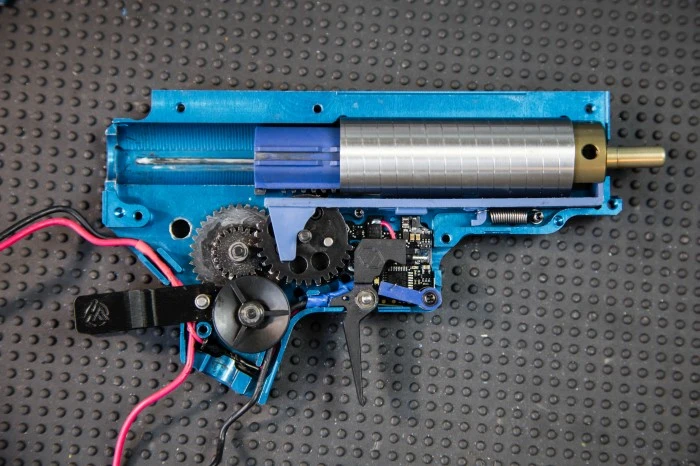
An AEG gearbox is a self-contained mechanical unit that houses all the critical components responsible for firing your rifle. When you pull the trigger, an electrical circuit closes, sending power from your battery to an electric motor. This motor drives a series of gears that compress and release a spring-loaded piston. The piston rapidly compresses air in a cylinder, which forces a BB through the hop-up unit and down the barrel.
Core Gearbox Components
Every AEG gearbox, regardless of version, contains these essential elements:
Gearbox Shell: The metal housing (typically aluminum, zinc alloy, or reinforced polymer) that contains all internal components. The shell's design and strength vary significantly between versions.
Gears: Three helical gears (sector, spur, and bevel) that transfer rotational energy from the motor to linear motion of the piston. Gear ratios determine rate of fire and trigger response.
Piston: A toothed component that travels backward and forward in the cylinder, creating air compression. Pistons feature metal or polymer teeth and rubber o-rings for air sealing.
Cylinder: A hollow tube where air compression occurs. Cylinders may be ported (holes for air release) or non-ported depending on barrel length requirements.
Cylinder Head: Seals the front of the cylinder and directs compressed air into the nozzle. Quality cylinder heads feature o-rings for optimal air seal.
Piston Head: Seals the rear of the cylinder and attaches to the piston. Like cylinder heads, quality piston heads use o-rings for air sealing.
Spring: Provides the energy storage mechanism. When compressed by the piston, the spring releases energy that drives the piston forward. Spring strength determines fps.
Spring Guide: Stabilizes the spring and may contain bearings to reduce friction and increase efficiency.
Nozzle: Channels compressed air from the cylinder head to the hop-up chamber and creates the air seal that propels the BB.
Trigger Assembly: Mechanical or electronic system that controls when the gearbox cycles. Includes trigger contacts, cutoff lever, and anti-reversal latch.
Motor: Converts electrical energy into rotational motion. Long-type and short-type motors exist, with different torque and speed characteristics.
Understanding these components helps you appreciate why gearbox version matters—different versions arrange and reinforce these parts in distinct ways to suit different rifle platforms.
The Tokyo Marui Legacy: Why Gearbox Versions Exist
To understand gearbox versions, we need to briefly explore airsoft history. Tokyo Marui, the Japanese company that essentially invented modern AEG technology, developed the first standardized gearbox designs in the 1990s and early 2000s.
As Tokyo Marui released new rifle platforms (M4s, AKs, MP5s, G36s, etc.), each required slightly different gearbox configurations to fit within the specific body dimensions and operation mechanisms of real firearms. Rather than creating completely unique gearboxes for each platform, Tokyo Marui developed a series of standardized "versions" that could be adapted across multiple platforms sharing similar characteristics.
The industry adopted Tokyo Marui's version numbering system, and it has become the universal standard. Today, manufacturers worldwide design AEGs using these established gearbox versions, ensuring parts compatibility and standardization across brands.
This standardization is excellent news for players—it means upgrade parts, replacement components, and technical knowledge apply across multiple rifle brands and models using the same gearbox version.
Version 2 Gearbox: The M4/M16 Standard
The Version 2 (V2) gearbox is the most common gearbox type in airsoft, found primarily in M4, M16, and AR-15 platform rifles. If you own an airsoft M4-style rifle from any manufacturer, it almost certainly contains a V2 gearbox.
V2 Design Characteristics
The V2 gearbox features a two-piece shell design that splits vertically along the long axis. This split allows easy disassembly—remove the screws, separate the halves, and access all internal components.
Key V2 features include:
- Two-piece shell construction for straightforward maintenance
- Motor in the pistol grip for realistic placement
- Separate motor plate adjustable for motor height
- Integrated trigger contacts within the gearbox shell
- Cutoff lever system that enables semi-automatic fire
- Compact dimensions fitting M4/AR-15 lower receivers
The V2's popularity means it has the most extensive aftermarket support of any gearbox version. Virtually every upgrade part manufacturer produces V2-compatible components, from drop-in MOSFET units to reinforced shells and high-performance gear sets.
V2 Strengths and Weaknesses
Strengths:
- Massive aftermarket parts availability
- Easy to work on for beginners
- Well-documented with extensive tutorials and guides
- Compatible with countless rifle models
- Efficient design with good performance potential
- Readily available replacement parts
Weaknesses:
- Shell strength issues around the rear section where motor connects
- Prone to cracking near the cylinder area with high-stress springs
- Requires careful shimming due to two-piece design
- Some versions have weaker trigger contact placement
Many manufacturers now produce "reinforced V2" gearboxes with additional material in stress-prone areas, addressing the original design's weak points.
Best V2 Applications
V2 gearboxes excel in:
- M4/M16 platform rifles of all lengths (full-length, mid-length, CQB)
- High rate-of-fire builds with proper reinforcement
- Entry to intermediate upgrade projects
- Players wanting maximum parts compatibility
- Builds requiring extensive customization options
Version 3 Gearbox: The AK Standard
Version 3 (V3) gearboxes are the backbone of AK-platform airsoft rifles. Compared to V2, the V3 features a fundamentally different shell design that offers superior strength at the cost of some complexity.
V3 Design Characteristics
Unlike the V2's vertical split, the V3 gearbox opens horizontally—the top plate removes to reveal internal components. This design creates a stronger, more rigid shell structure.
Key V3 features include:
- One-piece lower shell with removable top plate for exceptional rigidity
- Motor in the handguard area for AK-style rifles (motor position varies by application)
- Integrated motor cage in most designs
- Separate motor contacts plate that can be removed independently
- Stronger shell construction particularly around stress points
- Larger internal volume accommodating longer cylinders
The V3's robust construction makes it less prone to cracking and shell failure, even with powerful springs and high-stress applications.
V3 Strengths and Weaknesses
Strengths:
- Extremely durable shell design resists cracking
- Better heat dissipation due to larger shell volume
- Easier motor adjustment in most implementations
- Strong aftermarket support (second only to V2)
- Handles high-stress builds without reinforcement
- Longer cylinder options for DMR applications
Weaknesses:
- More complex disassembly than V2
- Heavier than V2 gearboxes
- Slightly less aftermarket variety than V2
- Requires more space, limiting platform compatibility
- Can be intimidating for first-time builders
Best V3 Applications
V3 gearboxes shine in:
- All AK platform rifles (AK47, AK74, AKM, RPK, etc.)
- G36 rifles and variants
- SIG series rifles
- High-power DMR builds requiring durability
- Outdoor field rifles with upgraded springs
- Players prioritizing longevity over weight
Version 6 Gearbox: The Hybrid Innovation
Version 6 (V6) gearboxes represent a hybrid approach, combining elements of V2 and V3 designs. Found primarily in P90 and MP7 platforms, V6 gearboxes accommodate bullpup and compact rifle designs.
V6 Design Characteristics
The V6 features a unique configuration where the gearbox sits behind the trigger mechanism, characteristic of bullpup designs:
- Compact dimensions fitting bullpup configurations
- Horizontal opening similar to V3
- Integrated motor cage within the shell
- Specialized cylinder positioning for unique platform requirements
- Modified trigger linkage accommodating remote trigger placement
Due to their specialized nature, V6 gearboxes have limited cross-platform compatibility. A P90 gearbox cannot be installed in an M4 or AK, making V6 the most platform-specific common version.
Best V6 Applications
V6 gearboxes are primarily found in:
- FN P90 replicas and variants
- H&K MP7 replicas
- Other bullpup or specialized compact designs
- Space-constrained platforms
While less common than V2 or V3, quality V6 gearboxes offer reliable performance in their specific applications. Upgrade paths exist but are more limited than mainstream versions.
Version 7 Gearbox: The Modern Update
Version 7 (V7) gearboxes are relatively recent additions to the airsoft world, designed specifically for AK74U and similarly compact AK variants. Think of V7 as a shortened, optimized V3 gearbox.
V7 Design Characteristics
V7 gearboxes maintain V3's robust shell design while accommodating shorter overall dimensions:
- Compact V3-style construction for short-barreled platforms
- Reinforced shell design similar to V3
- Shorter cylinder optimized for compact barrel lengths
- Similar parts compatibility to V3 in many components
- Specialized dimensions for specific platforms
The V7 allows short AK variants to maintain the durability advantages of V3 design while fitting in compact receivers.
Best V7 Applications
V7 gearboxes serve:
- AK74U and AKSU variants
- Compact AK platforms
- Short-barreled AK-style PDWs
- Players wanting V3 durability in compact packages
Lesser-Known Gearbox Versions
Beyond the mainstream V2, V3, V6, and V7, several other versions exist for specialized platforms:
Version 4: Found in FN FAL replicas, featuring unique dimensions for this specific platform.
Version 5: Used in UZI replicas and some other specialized submachine gun platforms.
Version 8: Designed for SVD and PSG-1 sniper platforms requiring specialized dimensions.
Version 9: Created for SIG 550/551/552 series rifles with unique receiver configurations.
These specialized versions typically have limited aftermarket support and are platform-specific. Most players will only encounter V2 or V3 gearboxes in their airsoft careers.
Choosing the Right Gearbox for Your Needs
When selecting anairsoft rifle, gearbox version should factor into your decision alongside aesthetics, brand, and price.
For Beginners
Best Choice: Version 2 or Version 3
New players benefit from mainstream gearbox versions due to:
- Extensive online tutorials and documentation
- Easy access to replacement parts
- Large community knowledge base
- Straightforward maintenance procedures
- Clear upgrade paths as skills develop
Start with a rifle using V2 (M4 platform) or V3 (AK platform) gearboxes. These offer the gentlest learning curve and most support resources.
For Intermediate Players
Best Choice: Any version matching your platform preference
Once you understand basic gearbox mechanics, version matters less than platform preference. Consider:
- Which rifle platform appeals to you aesthetically
- What upgrade parts are available for your chosen version
- Your intended use (CQB vs. outdoor, support vs. assault)
- Budget for future upgrades
At this level, select based on the rifle platform you want to run, knowing you can work with any major gearbox version.
For Advanced Players and Tech Enthusiasts
Best Choice: Version-specific based on build goals
Experienced players making specialized builds should consider:
High-ROF Builds: V2 with MOSFET, high-speed gears, and 11.1v LiPo batteries. The compact design and extensive parts availability make V2 ideal for extreme rate-of-fire projects.
DMR/High-Power Builds: V3 for durability with heavy springs (M140+). The reinforced shell handles stress better than V2, reducing failure risk in high-power applications.
Unique Platforms: Specialized versions (V6, V7, etc.) when building platform-specific replicas for MilSim events or collection purposes.
Maximum Reliability: V3-based platforms for players prioritizing durability over all else. The robust shell design simply lasts longer under identical stress.
Gearbox Maintenance and Longevity
Regardless of version, proper maintenance extends gearbox life and maintains performance.
Regular Maintenance Tasks
Every 5,000-10,000 Rounds:
- Open gearbox and inspect for wear
- Re-lubricate gears with quality airsoft grease
- Check piston teeth for chipping or wear
- Verify air seal components (o-rings, cylinder head)
- Clean debris and old lubricant
Every 20,000-30,000 Rounds:
- Replace piston if teeth show significant wear
- Consider replacing cylinder head o-ring
- Check gearbox shell for cracks (especially V2)
- Replace spring if fps has dropped noticeably
- Rebuild trigger assembly if contacts are worn
As Needed:
- Replace anti-reversal latch if worn
- Upgrade to steel tooth piston for durability
- Install MOSFET to protect trigger contacts
- Shim gears if noise increases
- Upgrade bushings to bearings for efficiency
Version-Specific Considerations
V2 Gearboxes: Pay extra attention to the rear shell area where the motor plate connects. This is the most common failure point. Consider upgrading to reinforced shells if running powerful springs (M120+) or high rate-of-fire setups.
V3 Gearboxes: While more durable, V3 gearboxes can develop top plate alignment issues if not properly reassembled. Ensure even screw tension when closing the gearbox to maintain proper alignment.
V6/V7 Gearboxes: Due to limited aftermarket support, source quality OEM parts when replacing components. Generic upgrade parts may not fit correctly in specialized versions.
Upgrade Paths by Gearbox Version
Understanding which upgrades work with your gearbox version helps you plan effective performance improvements.
Universal Upgrades (All Versions)
These upgrades work across all major gearbox versions:
- Steel tooth pistons (replace polymer teeth)
- Aluminum or brass cylinder heads (improved air seal)
- Ported cylinders matched to barrel length
- Quality hop-up units and buckings
- Precision inner barrels (6.01-6.05mm)
- High-torque or high-speed motors
- Upgraded springs (within safe limits)
Version 2 Specific Upgrades
V2's massive aftermarket allows specialized upgrades:
- Drop-in MOSFET units (GATE, PERUN, Jefftron)
- Quick-change spring systems
- Reinforced gearbox shells (RetroArms, Lonex)
- Optical MOSFET trigger systems
- Advanced programmable control units
- Radiused gearbox shells (pre-stressed relief cuts)
Version 3 Specific Upgrades
V3 upgrades focus on optimization rather than reinforcement:
- Extended cylinders for DMR applications
- Heavy-duty spring guides for M140+ springs
- Reinforced piston heads for high-power builds
- Quick-change spring systems (less common than V2)
- Trigger response enhancement parts
The Canadian Context: Gearbox Versions and FPS Requirements
Canadian airsoft players must maintain6mm airsoft velocities between 366-500 fps with 0.20g BBs for legal ownership without firearms licensing. Gearbox version affects how easily you can adjust and maintain these velocities.
Velocity Adjustment Considerations
Quick-Change Spring Systems: Available primarily for V2 gearboxes, these systems allow spring changes without fully disassembling the gearbox. This convenience helps Canadian players:
- Adjust fps for different field requirements
- Compensate for seasonal velocity changes (gas rifles aren't the only ones affected by temperature)
- Maintain compliance as springs weaken over time
- Experiment with different power levels safely
Spring Availability: Both V2 and V3 have excellent spring availability in the M100-M120 range that keeps most rifles in the 366-450 fps sweet spot for Canadian fields. Specialized versions may have more limited spring options.
Chronograph-Friendly Designs: Mainstream gearbox versions have well-documented fps characteristics, making it easier to predict velocity with specific spring combinations. This predictability helps ensure Canadian compliance.
Future of Gearbox Technology
Airsoft gearbox technology continues evolving. Current trends include:
Electronic Control Units: Advanced MOSFETs and control systems that manage gearbox function electronically, providing features like burst fire, pre-cocking, and programmable fire modes.
Brushless Motors: More efficient motors that produce less heat and offer better trigger response than traditional brushed motors.
Enhanced Materials: Reinforced polymer and advanced alloy shells that reduce weight while maintaining or improving strength.
Modular Designs: Gearboxes with easier component access and tool-free adjustments for quick maintenance.
Integrated Sensors: Smart gearboxes with shot counters, temperature monitoring, and diagnostic capabilities.
These innovations build upon traditional V2 and V3 platforms rather than replacing them, ensuring the fundamental version system remains relevant.
Conclusion: Choosing Your Gearbox Wisely
Understanding gearbox versions transforms you from a casual buyer into an informed consumer who can make smart purchasing and upgrade decisions. While gearbox version shouldn't be your only consideration when choosing anairsoft rifle, it significantly impacts long-term satisfaction, upgrade potential, and maintenance requirements.
Key Takeaways:
- V2 (M4/M16 platform): Most common, maximum aftermarket support, good for beginners
- V3 (AK platform): Most durable, excellent for high-power builds, slightly more complex
- V6/V7 (Specialized): Platform-specific, limited but adequate support
- Maintenance matters: All versions require regular care for longevity
- Upgrades are version-specific: Research compatibility before purchasing parts
- Canadian compliance: All versions can maintain 366-500 fps with proper springs
Choose your gearbox version based on your preferred rifle platform, upgrade ambitions, and playing style. With proper maintenance and quality components, any major gearbox version will provide years of reliable performance on Canadian airsoft fields.
Whether you're running an M4 with a bulletproof V2, an AK with a tank-like V3, or a specialized platform with a unique gearbox version, understanding what's inside your rifle empowers you to maintain, upgrade, and optimize performance for maximum enjoyment of this incredible sport.


