
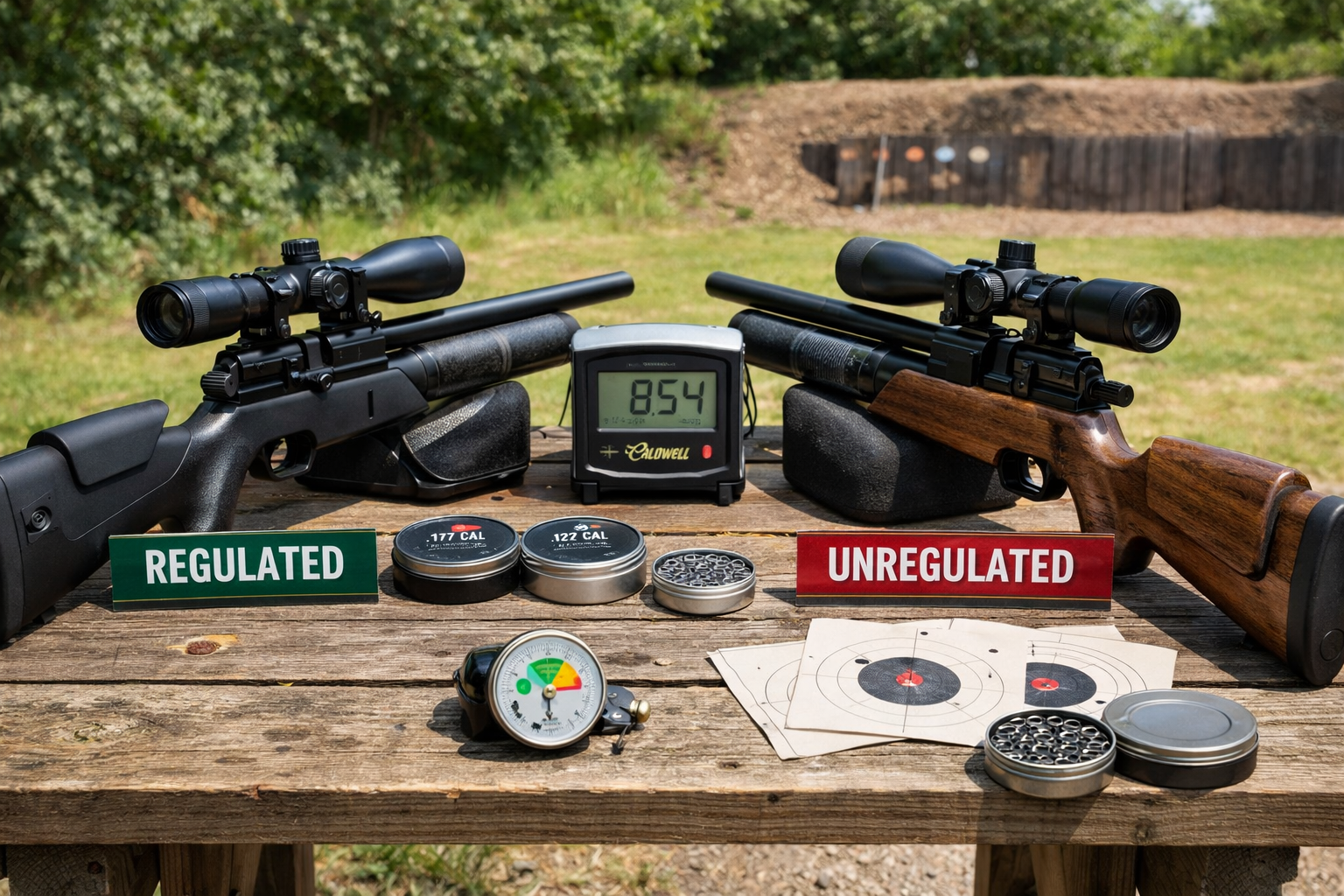
Regulated vs Unregulated PCPs: How Regulators Impact Your Shooting Day
Why “regulated vs unregulated” matters on a real shooting day
Most shooters start thinking about power, accuracy, and build quality when shopping for a PCP air rifle. But one feature quietly shapes how your rifle behaves from the first shot to the last: the regulator. Understanding regulated PCP vs unregulated isn’t about chasing a buzzword—it’s about predictability. It affects how often you refill, how much you adjust your scope, and how confident you feel when you take a careful shot.
This article breaks down a PCP regulator explained in practical terms, then shows how it changes PCP shot count, consistent PCP velocity, and overall feel on the range or in the field.
What is a PCP regulator?
If you’ve ever asked, what is a PCP regulator, the simplest answer is: it’s a pressure control valve inside the airgun that feeds the firing valve a steady, pre-set pressure, even though the main air reservoir starts full and gradually empties.
A PCP stores compressed air in a cylinder or bottle. Without regulation, the pressure available to push the pellet changes every time you shoot. With regulation, the rifle “steps down” that high storage pressure to a consistent working pressure (often called the regulator setpoint), and the valve uses that consistent supply to propel the pellet.
PCP regulator explained with an easy analogy
Think of your main tank as a large water tower. Pressure is high when it’s full, and it drops as it empties. A regulator is like a pressure-reducing station that ensures the water reaching your house comes at the same pressure all day. Your pellet “sees” the house pressure, not the tower’s changing pressure.
How an unregulated PCP behaves: the “power curve”
An unregulated PCP typically follows a velocity curve as reservoir pressure drops. Early shots may be slower or faster depending on valve design and tune, then the rifle enters a “sweet spot” where velocities are most consistent, and finally velocities fall off as pressure gets too low.
In real-world use, that means you’ll often manage your shooting around a usable window. Many experienced owners learn their rifle’s preferred fill pressure and stop shooting once velocity begins to drop significantly.
Typical signs you’re on an unregulated power curve
- Point of impact shifts over a long string, especially at longer distances.
- Velocities vary more shot-to-shot unless you stay in the sweet spot.
- More “feel” changes (sound, recoil impulse, report) as the pressure changes.
How a regulated PCP behaves: a flatter velocity “plateau”
A regulated PCP is designed to deliver a more level string of shots. Once the regulator is operating in its normal range, the firing valve receives a steady supply pressure, which makes it easier to achieve consistent PCP velocity across a large portion of the fill.
Eventually, you’ll reach a point where the main reservoir pressure falls to (or near) the regulator setpoint. At that stage, the regulator can’t maintain the same output pressure, and velocity will drop off. But until that point, the experience is usually more predictable.
Regulated PCP benefits you notice immediately
The phrase regulated PCP benefits often gets reduced to “more consistent,” but the day-to-day advantages are broader than that.
1) More consistent velocity (and easier dope)
Consistent velocity helps reduce vertical stringing at distance. It also makes your scope holds more reliable. If you’re shooting field targets, benchrest, or simply stretching out to longer ranges, stable velocity reduces the need to chase impacts with click adjustments during a session.
2) Shot count can be more usable, not just “higher”
When people talk about PCP shot count, they often mean “how many pellets per fill.” But the better question is: how many good shots per fill? A regulator can increase the number of shots that stay within a tight velocity spread, turning more of your air fill into shots you’d actually trust for precision.
3) Less pressure babysitting
With many unregulated rifles, experienced users fill to a specific pressure, shoot down to a specific pressure, then refill. With a regulated rifle, you’re often free to fill to the recommended max and shoot until you approach the regulator’s lower limit—less monitoring, less guessing.
4) Better platform for tuning
Regulated systems can make it easier to tune for a specific goal (efficient plinking, a particular power level, or a preferred pellet). A stable feed pressure gives you a repeatable baseline when adjusting hammer spring tension, valve dwell, or transfer port settings (where applicable).
When unregulated can be the right choice
Unregulated does not mean “bad.” Plenty of excellent PCPs are unregulated by design, and some shooters prefer the simplicity. There are also setups where the benefits of a regulator are smaller or come with trade-offs you may not want.
Situations where unregulated shines
- Simplicity and fewer parts: Fewer components can mean easier maintenance and less to diagnose if performance changes.
- High-power setups: Some high-output tunes rely on the natural reservoir pressure curve or a valve designed to work efficiently across a wide pressure range.
- Short strings: If you typically shoot 10–20 rounds at a time and refill frequently, a well-understood sweet spot may be all you need.
- Preference for “air management”: Some shooters like learning their rifle’s curve and using it intentionally (for example, slightly higher velocity early for one task and a softer tune later).
Does a regulator always increase PCP shot count?
Not always in the way people expect. A regulator can improve efficiency by letting the valve operate in a more optimal pressure range, which often yields more consistent shots and sometimes more total shots. But it depends on the rifle’s design and tune.
In some cases, installing or using a regulator without proper tuning can actually reduce useful shots if the setpoint doesn’t match the valve/hammer setup. The biggest “win” is usually an increase in usable shots within a tight velocity range, not necessarily a dramatic increase in total shots fired before the gun drops off.
What really drives shot count
- Reservoir volume: Bigger cylinder/bottle generally equals more air to use.
- Fill pressure: 232 bar vs 300 bar fills can change available air significantly.
- Power level: Higher energy per shot consumes more air.
- Efficiency/tune: Valve design, hammer settings, and transfer port all matter.
- Regulator setpoint: Too high or too low can hurt efficiency or consistency.
Consistency: what changes on target?
Velocity consistency matters most as distance increases. At close range, a moderate velocity swing might not move point of impact much. As ranges extend, vertical dispersion becomes more noticeable.
With a regulated rifle, the goal is a long “plateau” of stable speed. With an unregulated rifle, the goal is to shoot within the portion of the curve where the rifle behaves predictably.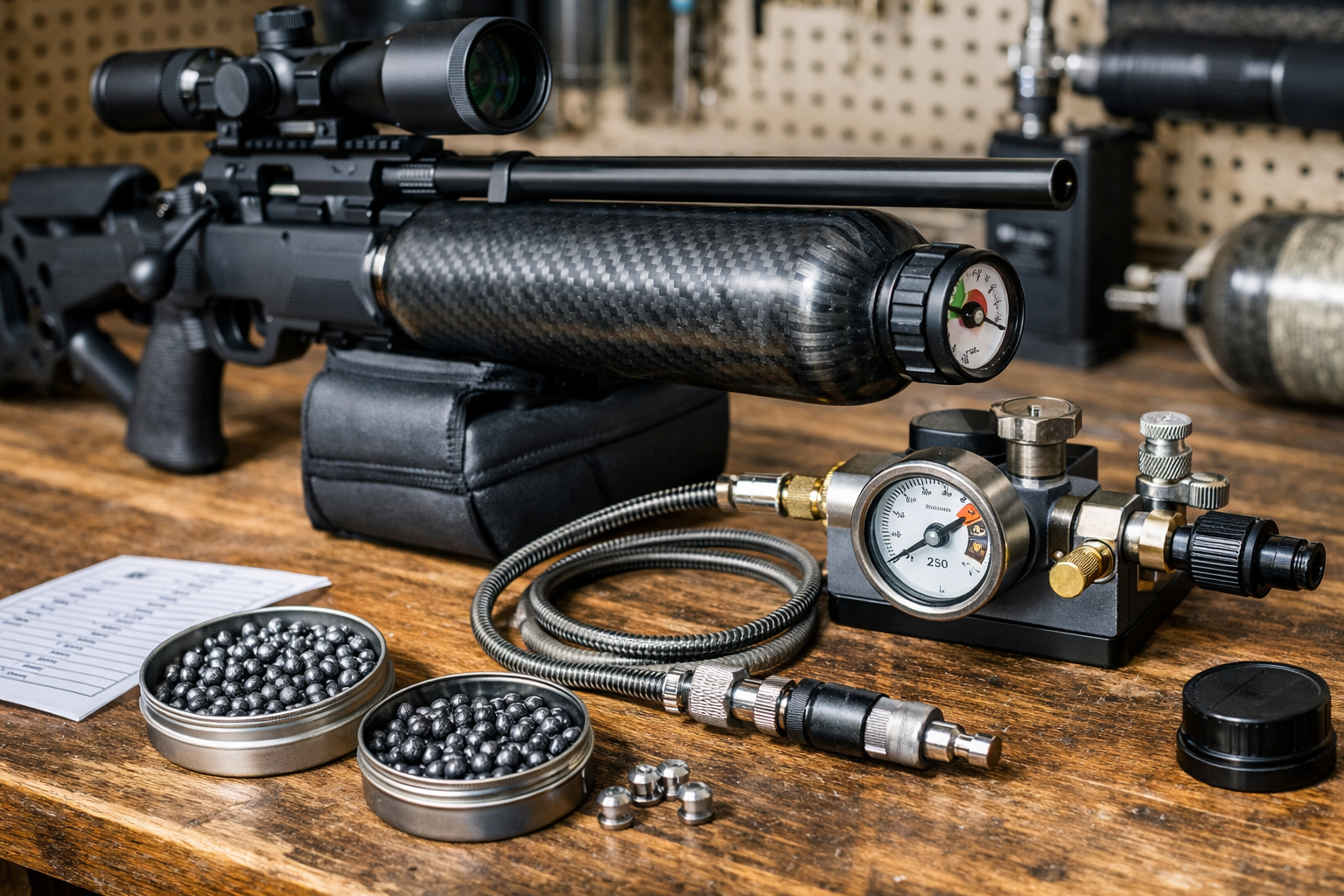
A practical example (conceptual, not brand-specific)
If a rifle varies by 30–40 fps across a long string, you may see noticeable vertical spread at longer distances, especially with lighter pellets. If it stays within 10–15 fps for most shots, your elevation holds tend to be more repeatable. That difference is what most shooters feel when they say a regulated gun is “easier” to shoot well.
Trade-offs and myths about regulated PCPs
Regulators are valuable, but it’s worth understanding what they don’t do.
Myth 1: “Regulated means more accurate”
Accuracy is primarily a function of barrel quality, pellet compatibility, consistency in lockup and harmonics, and shooter technique. A regulator helps by supporting consistent velocity, which can make it easier to realize the rifle’s accuracy potential—especially at longer ranges—but it doesn’t guarantee tight groups by itself.
Myth 2: “Regulators never need attention”
Regulators are mechanical systems with seals. Over time, they can require service. One common issue is “regulator creep,” where output pressure rises between shots due to sealing behavior. Many modern designs minimize this, but it’s something informed owners should be aware of.
Myth 3: “Unregulated rifles are inconsistent”
Many unregulated PCPs have well-designed valves and can be very predictable in their sweet spot. If you chronograph the rifle and learn the curve, you can get excellent results—especially for shorter strings or specific use cases.
How to choose between regulated PCP vs unregulated
If you’re deciding between a regulated PCP vs unregulated model, start with how you actually shoot.
Choose regulated if you value:
- Long strings with minimal point-of-impact shift
- Simpler “fill and shoot” routine
- Consistency for target work (benchrest, field target, longer-range plinking)
- Repeatable tuning for a specific pellet and velocity
Choose unregulated if you value:
- Mechanical simplicity
- Learning and using a power curve intentionally
- Potentially lower complexity for long-term ownership
- Shorter sessions where you can stay in the sweet spot easily
Questions to ask (and numbers that matter)
Whether a rifle is regulated or not, a few practical checks will tell you how it’s likely to behave.
- What’s the recommended fill pressure? (232 bar, 250 bar, 300 bar)
- If regulated, what’s the regulator setpoint? And is it adjustable?
- What is the claimed shot count? Ask whether that’s within a tight velocity spread.
- What caliber and typical power level? .177 at modest power often yields more shots than .25 at high power.
- How will you fill? Hand pump, carbon-fiber tank, or compressor—your fill method affects how much you care about efficiency.
Getting the most out of either system
You can improve your shooting day with a few habits, regardless of regulation.
Chronograph once, benefit for years
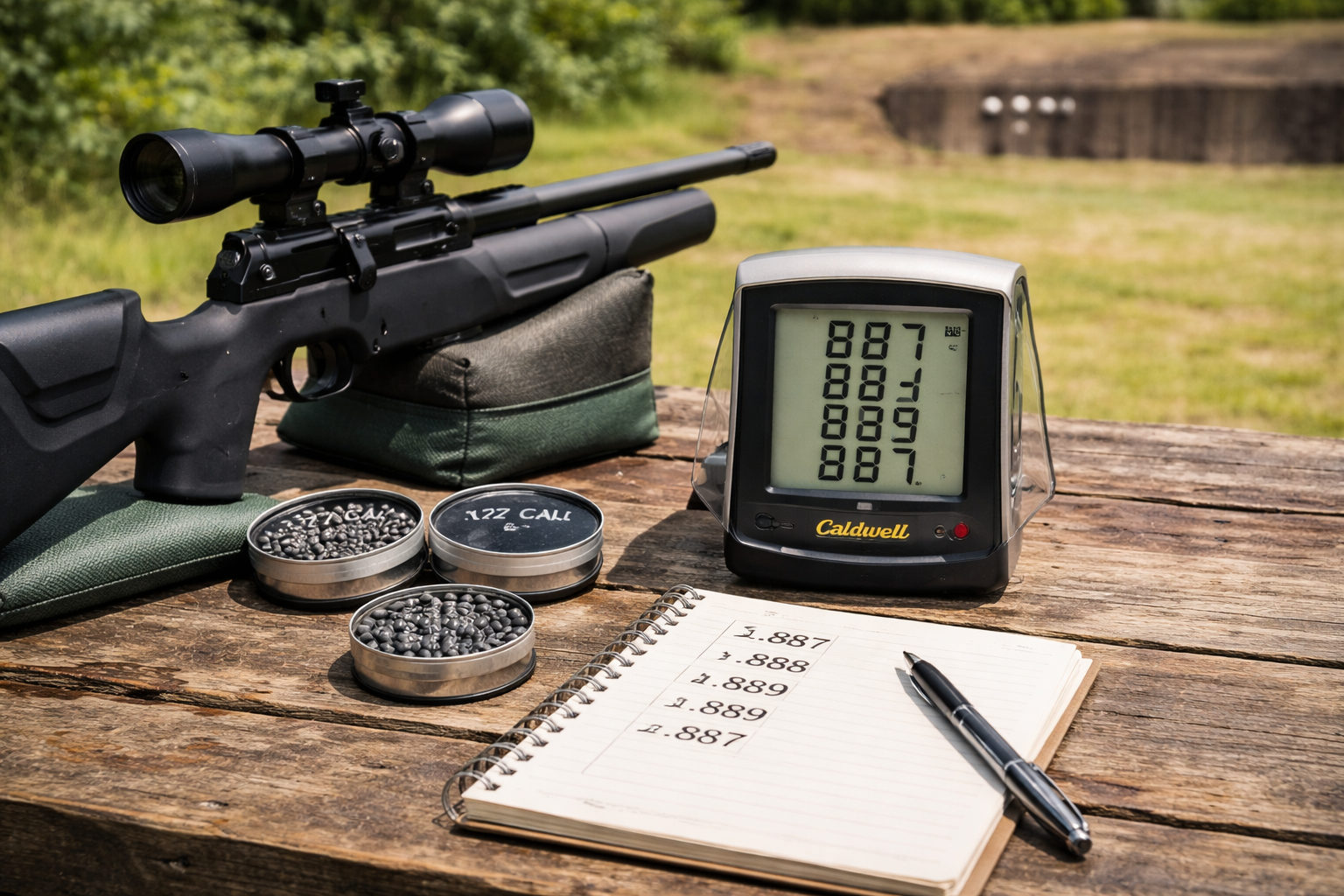
A chronograph is the fastest way to understand your rifle. For an unregulated PCP, it reveals the sweet spot and the best fill-to-stop window. For a regulated PCP, it confirms the length of the plateau and shows when you’re dropping off the regulator.
Track your fill routine
Write down starting pressure, ending pressure, pellet choice, and approximate shot count. Over a few sessions you’ll build a reliable picture of your personal PCP shot count under your conditions.
Use clean, dry air and protect seals
Moisture and debris can shorten seal life. Good fill practices help every PCP, but they’re especially important in regulated systems where stable sealing is key to stable output pressure.
Where to learn more about PCP rifles and accessories
If you’re still narrowing down which type fits your needs, it helps to look at how different rifles approach power, reservoir size, and features alongside regulation. You can browsePCP Rifles to compare platforms and configurations, and explorePCP Accessories for filling and maintenance essentials.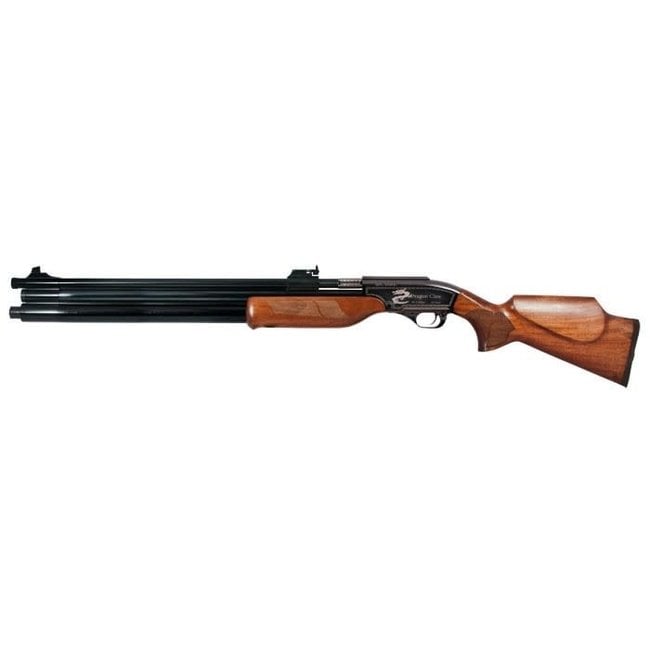
For a broader framework on selecting a PCP (beyond regulation alone), seeHow to Choose the Right PCP Rifle: A Buyer's Guide.
Bottom line
A regulator is a tool for control. If your priority is predictable performance—especially over longer strings—a regulated PCP’s stable pressure supply can make your shooting day feel smoother and more consistent. If you prefer simplicity, enjoy learning the rifle’s character, or typically shoot short strings, an unregulated PCP can be equally satisfying and highly effective.
Either way, understanding how pressure, shot count, and velocity consistency interact will help you get better results with fewer surprises from the first shot to the last.


